Popular Posts

Showing posts with label heroes. Show all posts

Monday, 15 March 2021

Inspiring people during the Pandemic

The current pandemic has brought much disruption and hardship. Lamenting the people and routines we have lost are a healthy part of coping with this pain and suffering.  This blog post will be sharing some stories of people who have inspired me during the pandemic.  Perhaps their stories will also encourage and inspire you.

Connectors

When meeting with people outside of our households became impossible, three seniors I know decided to reach out in original and inspiring ways.

HANK

This man has the gift of singing and story telling.  He is a retired teacher and principal who lives alone, but he has grown a ministry during the pandemic that has continues to grow.  Each week, he telephones a roster of 60 people who live alone or are isolated in some other way.  He calls to make a personal connection and to sing a song for them over the telephone. Most of the time, these songs are hymns. He researches the story that led to the writing of the song and shares this background with the person he is calling.  Then, acapella, he sings the song.  One song he has sung for people is "One Day at a Time."  I am not on his phone list, but I heard him sing it at an anniversary party in 2019. The words and the conviction with which he shared them still stand out in my mind.

DENNIS

Another retired gentleman decided last spring to open up his paper address book and pick up the phone to call someone he might not have spoken with for some time.  He called someone different every day. People who received his call expressed gratitude, and they shared together what has been going on in their lives lately.  In a world of text and email, the sound of a human voice is still a treat. The boldness and determination to call these contacts is inspiring.

NEL

This retired woman comes from a large family.  Eight of her siblings are still alive, and one passed away a few years ago.  She and her late husband used to own a successful business, and they had no children. At Christmas time, she wanted to bless each of her sisters and brothers with a generous financial gift. The most inspiring part of this story is that she included her widowed sister-in-law in the disbursement.  She had no obligation to do so, and she had to insist to her accountant that this was what she wanted to do, regardless of what the accountant advised.  The ripple effects of her gift extended far beyond what Nel imagined, since one of her sisters also shared the windfall with her children and grandchildren.

Physical Fitness

For many people, the disruptions of pandemic life meant less activity and exercise.  Two individuals did not let the pandemic stop them from continuing to strive for lofty goals of fitness.

MARJORIE

I am not sure how long this woman who lives on my street has had her current walking regimen.  She walks ten kilometers every day, no matter the weather.  Now, she did not announce this to me.  Rather, as I picked up the habit of walking every day when I started working from home in March 2020, I would sometimes encounter her on various streets.  She moved with purpose and was dressed for exercise. I would greet her and carry on with my own walk or errand on foot.  Finally, I stopped her and asked how far she walks.  I was floored when she said she walks ten kilometers every day.  Her job has recently become permanently a "work from home" position.  She loves that, and it does not stop her from being active every day.

CHRIS

When I heard about the achievement Chris had made on the radio in November 2020, I was so excited.  Chris is a 21 year old young man who lives in Florida.  He completed an ironman race that included cycling, swimming and running.  He is the first person with Down Syndrome to accomplish this feat.  In the interview with his father, it was stated that Chris trained for more than a year to prepare for this event. To spare Chris unneccesary pain or hardship, his father and trainer set out a goal of 1% improvement each day. The length of time in the water, on a bike or on the track was increased gradually.  This principle of gradual, 1% improvement in even one area of life is inspiring for me.  It is something achievable and can become a part of a sustainable lifestyle!

I'd love to hear about people in your life who have inspired you during the pandemic.  There is plenty of gloomy news out there, but as the Apostle Paul encourages, "Whatever is true, whatever is noble, whatever is right, whatever is pure, whatever is lovely, whatever is admirable, if anything is excellent or praiseworthy, think about such things" [Philippians 4:8, NIV].

Friday, 17 May 2019

Biography Poem for C.S. Lewis


In 1898 in Northern Ireland he was born,
He had an older brother, Warren.
Together they made imaginary lands
At their country house with few demands.

Sadly, his mom died when he was just ten,
In those days kids weren’t raised by men.
Off to boarding school he was sent,
Only summers at home were spent.

Reading and study he loved to do;
He became a professor of philosophy and English too.
He did not believe in God for years
Until he turned to him with tears.

He knew the Bible all was true
And began speaking about his faith so new.
On the radio and in books he told
That Jesus was worth far more than gold.

Those childhood stories came back to mind
In two different fantasy series he designed.
The one best known of Narnia tells
Where the lion Aslan sometimes dwells.

C.S. Lewis preferred to be called Jack.
Most of his friends were taken aback
When he married a woman named Joy
Who already had more than one little boy.

When Joy got cancer and died
C.S. Lewis truly cried.
He cared for sons Douglas and Dave
Until he joined her in the grave.

C.S. Lewis died at age sixty-five.
The “C” in his name stands for “Clive.”
His fantasy world begun in a wardrobe,
Now reaches all over the globe.

Wednesday, 15 August 2018

Hidden Figures Part 1: A film connecting to a Bigger Story

   The successful book and film Hidden Figures tells the true story of women who were instrumental in the American space program in 1962 and onward.  This film came out in 2016, but it continues to generate income and capture hearts because its message connects to a bigger story in our culture, including Black Lives Matter and #MeToo.  The discrimination faced by Dorothy Vaghan, Mary Jackson and Katherine Johnson based on gender and race is tackled head-on.  Alan Shepherd and John Glenn are household names, but without a vast team of support staff at NASA there would be no rocket, no launch and no successful re-entry.  The three women documented in the film give us another angle to explore the operations at NASA's site in Virginia in light of a budding civil rights movement, the infancy of the IBM computer and the hopefulness of the Kennedy presidency.
   The clever pun in the title--figures--denotes both persons and the mathematical operations they performed, and that is how this film points to an even bigger story than early efforts to further opportunities for women and Blacks in America.  The rooms filled with engineers and human computers remind us that most people remain anonymously in the background when great achievements happen.
   Think, for example, of the first man to make it to the North Pole.  This achievement is given to one person, named Robert Peary.  The first Western person to climb Mount Everest, with cameras to prove it, was Sir Edmund Hillary.  However in both cases we easily forget that without their Inuit and Sherpa guides, respectively, neither of these triumphs would have been recorded.  Hundreds of porters were involved even further behind the scenes to carry the 13 tons of baggage to the base camp at Everest [1]. In the case of Robert Peary, there were other hidden figures besides the team of Inuit men who guided him.  There was African American Matthew Henson who has only recently been recognized as instrumental to the success of the trek and also Captain Robert Bartlett, who may have been deliberately left at a base camp so that the glory would not have been shared with him.
   Upon reflection, no invention or accomplishment can be claimed by any one individual.  Not only the network of people around him or her need to be acknowledged but also the technologies and advancements that have paved the way.  Staying with the examples already cited, technologies like the Inuit inventions of sleds and warm clothing, navigation systems, mountain climbing equipment, such as crampons and snow goggles were essential.
   Such acknowledgements are seen, to a certain extent, at awards ceremonies where recipients name or refer to the people who have helped them along the road to their achievements.  Nevertheless, even in the smaller achievements that we take pride in, it is good to remember that we could not have done these difficult things alone or without infrastructures we take for granted.  Admitting this is not just humility, it is honesty.

[1] See the photo caption on https://www.theguardian.com/travel/gallery/2013/may/23/mount-everest-first-successful-ascent-in-pictures

Saturday, 19 September 2015

The "Imagine" Reality Check: Orphan Care

After having taken a short break, I am resuming this series.  Singer-songwriter John Lennon wrote a song decades ago asking people to imagine a world with no religion as though it would automatically lead to peace and harmony among people.  Through this series I have been exploring the contributions of Christianity to Western culture, some of which have become such "givens" that many do not realize that they came to us thanks to people properly living out their religion.
Freerange stock photo


   It may be surprising to most people that the word “religion” is hardly ever used in the Christian Bible.  One place it is used is in the highly practical letter of James.  Here we find these words:
Religion that God our Father accepts as pure and faultless is this: to look after orphans and widows in their distress and to keep oneself from being polluted by the world. (James 1:27)
In this post, I will focus on the way Christians from the beginning were people who looked after orphans in their distress.
   Jesus Christ and his first followers lived in the context of the Roman Empire.  However, they lived within a Jewish enclave of that empire, where many laws, traditions and ways of living continued to be practiced even if they were not universally shared.  When the first followers were dispersed throughout various pockets of the Roman Empire, they may have found a Jewish synagogue or a small worshipping community of Jews by a river side (see Acts 16:13), but Greco-Roman patterns and ethics dominated all of society.
   Greco-Roman attitudes regarding the value and status of women, children and slaves affected their everyday interactions with each other and colored their sense of justice as well.  Because infants and children were not valued, it was common for them to be abandoned at birth if the parents did not want to raise them.  Such children either died of cold or hunger or were seized by slave traders who would exploit them. Christians began to rescue and embrace these infants, raising them with “the aid of the community fund.” [1] 
   Apostolic Constitutions (eight treatises dated from 375 to 380 (Book IV) Section 1. On Helping the Poor refer to the practice within the church for members to adopt and raise any Christian child whose parents had lost their lives whether by martyrdom or natural causes.  Orphanages as an institution began to be opened in the East at the same time as St. Basil was founding hospitals in the early fourth century. 
   A prominent Christian who cared for children in orphanages was George Muller, a German-born missionary who came to London to evangelize Jews.  Eventually he settled in Bristol at a time when a cholera epidemic was decimating the population.  So many children were left without parents that Muller took action and started Orphan Homes.  Eventually there were five of them, without any fundraising or asking for money.  Muller strongly believed that the Lord would provide financially without his approaching any individuals or groups. In all over 10,000 children were cared for in Muller’s homes. [2]
   Christian missions overseas have also often focused on the need to provide care for vulnerable orphans.  This has taken various forms, including adoption (for example, the cases of missionaries Amy Carmichael and Gladys Aylward in India and China, respectively), establishing orphanages, and more recently by organizing and supporting foster care within the child’s own community (such as is done by Visionledd in African nations ravaged by AIDS). 
   As I was researching orphan care, one of the things that popped up in my browser search was a news story about “the first atheist orphanage.”  A group of humanists announced in the February 2015 article that they would open the first atheist orphanage and would rely on crowd funding.  I suppose this really is newsworthy because it admits that faith has motivated the vast majority of homes for orphans.  Furthermore, it shows that through all the years of human history it has taken thousands of years before someone of no religion felt inclined to launch such an initiative.

[1] Will Durant, Caesar and Christ (1944), p. 598; also E. Gibbon, The Rise and Fall of the Roman Empire (1900), p. 480.
[2] See www.Muller.org

Monday, 14 September 2015

Coptic Object Lesson

   On the weekend (Saturday, September 12th) the Coptic Orthodox community celebrated its new year.  This festival coincides with a remembrance of martyrs, people who have died for their faith in the present and especially in generations past under the persecution of Emperor Diocletian.  The name Nayrouz refers to martyrs.
   On Saturday afternoon while attending a birthday party I met a Coptic family: a father, mother and two teenage daughters.  The father and younger daughter had been in Toronto that morning at a celebratory conference in honour the festival of Nayrouz.  The younger daughter held out her hand and showed us she had saved a pit from a date she had eaten there.  The older daughter immediately knew why she would do this, and the father quickly explained it to me.  For Coptic people, the fruit of the date palm has a special significance.  It reminds them of the martyrs in the following ways:

  • The outside of the date is reddish-brown, which signifies the blood and suffering of the martyrs
  • The inside of the date is white (as you can see on the image).  This represents the purity of the hearts of those who remained true to their faith even to death.
  • The seed of the date is hard, and it reminds Coptic Christians of the firm and resolute faith that enabled the believers to face a martyr's death.
   I later learned that the importance of martyrs carries over to the Coptic calendar in one other way: instead of beginning the counting of years at the birth of Jesus Christ, they begin at AD 284 and designate each year A.M. (Anno Martyrum), in the year of martyrs.  Thus, in the traditional Coptic calendar the year is 1732.  I realize that the math does not work exactly, but there must be a good reason for that. 

Friday, 19 September 2014

Not A Waste: The Short Life of Keith Green

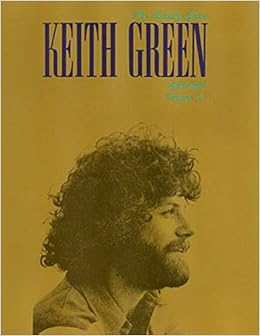
Cover of songbook
   Keith Green was born in 1953 in New York City; from a very early age he showed much musical promise.  He had perfect pitch at the age of two, could play the ukulele at age five, played guitar and piano, wrote his own songs and signed a recording contract when he was just eleven years old.
   In those days record companies did not know how to market young musicians, and this led to some disappointment for Keith as a teenager.  He ran away from home and explored all kinds of spiritual avenues to make sense of life.
   In 1975, he embraced faith in Jesus Christ and began writing music to reflect this new beginning in his life.  His passionate plea to whomever was in the audience was to live for God wholeheartedly. In the years following his conversion, Keith Green released five albums.  He was not interested in making money but gave away his music and made his concerts free (a free will offering was taken). That attitude of ministry included opening his home to people trying to turn their lives around such that it was nicknamed "the Greenhouse," a protected place where growth could occur.  Along with his wife, they also produced literature and began an organization called Last Days Ministries.
   Keith Green's life on this earth was brought to a sudden halt by a plane crash in 1982, which also claimed the lives of two of his children.  He was only 28 years old at the time.
   Although he died over thirty years ago, his influence lives on and many of his words remain prophetic.  Even then, some of the music known as "Christian contemporary" did not seem to line up with Jesus' way of doing things.  I leave for your consideration a paragraph from a pamphlet he wrote entitled "Can God Use Rock Music?":

    It isn't the beat that offends me, nor the volume - It's the spirit. It's the "Look at me!" attitude I have seen in concert after concert, and the "Can't you see we're as good as the world?" syndrome I have heard on record after record. Jesus doesn't want us to be as good as the world, He wants us to be better! And that doesn't mean excelling them in sound, style, or talent - it means surpassing them in value - in our motives for being up there on stage, in our reasons for singing our songs, and especially in who we're singing for! If there's anything wrong or worldly at all about so-called "Christian rock," it's the self-exalting spirit and attitude that comes across so loud and clear in many of the records and concerts today.  [1]

   Keith Green's example of humility and the plainspoken message remains a model of what music ministry ought to be.  

Monday, 18 August 2014

A Door to a New World

 
 The image of a door that opens to a new world and/or a new reality appears often in literature.  We have the wardrobe's door in the Narnia books, the door into the Secret Garden and the platform 9 3/4 in the Harry Potter books, just to name a few.  The word door has this association for most people, and at times when we speak of something being "five doors away", it includes the entire house or room that the door leads into.  When you read or hear the word door, you may have in mind the concept of a physical door (swings open and closed, has a knob or handle by which it can be opened, is able to be locked or unlocked, may contain a window, strong, sturdy).  Some people, who are visual thinkers, picture specific doors they have encountered in their lives whenever this word comes up, and it plays in their brains "like Google images" [1].  One such person is a woman named Temple Grandin.

   Ms. Grandin was born in Boston in 1947 and at a young age was diagnosed with autism.  She began speaking later than most children and had difficulty interacting with others socially.  If we consider autism to be enigmatic today, multiply that several times in the 50's and 60's when she grew up.  Despite obstacles, Grandin graduated from high school and college, earning both a Master's Degree (1975) and a Doctorate in Animal Science (1989).
   Something depicted well in the HBO Film Temple Grandin was the way in which her high school science teacher helped her conceptualize her future in college.  Dr. Carlock said to her:
        "Think of it as a door.  A door that is going to open up onto a whole new world for you.  And all you
        need to do is decide to go through it."
Several times in the film, Temple Grandin needs to go through a scary door to get to the new world she will become part of--from the frightening automatic door at the grocery store that reminds her of a guillotine to the door of a slaughterhouse she will ultimately redesign to be more humane and the cinematic door she walks through to speak publicly about autism at a national conference. 
   Temple Grandin is an individual who has been tremendously influential in the area of treatment of animals at slaughter facilities by using her visual mind and attention to detail.  As she heroically stepped through various doors, she also extended "the horizons of the possible" [2]  for many others.

[1] Temple Grandin. "The World Needs All Kinds of Minds" TED talk, 2010.
[2] Andy Crouch Culture Making (2008), pp. 17-36

Wednesday, 16 July 2014

Not a Waste: Parallel Lives of Eric Liddell and Dietrich Bonhoeffer

   I'm probably not the first person to notice some striking similiarities between two men of honour born just after the turn of the century who also passed  away within two months of each other in the year 1945.  These men are Eric Liddell and Dietrich Bonhoeffer. I will begin with a short summary of each man's life and then point out the common strands I observed while reading about them.
   Eric Liddell was born on January 16, 1902 to Scottish missionaries living in China.  His education from a young age took place with his brother at British boarding schools far away from his parents and sister, who continued to live and minister to the Chinese people.  Family visits took place infrequently during furloughs. Young Eric was not terribly academic, but he enjoyed the sport of rugby and running races.  In 1924, the eighth modern Olympic games were held in Paris, France, and Liddell was one of the members of the British team.  His best event would have been the 100 metre sprint, but when it became known six months before the event that the qualifying races would take place on Sunday, Liddell determined not to run. Instead he trained for the 200 metre and the 400 metre events, which would not require competing on the Lord's Day. After all of the celebrity that came through his gold medal performance in the 400 metre race, Eric Liddell remained humble.  He desired to use his athletic ability to connect people with spiritual truths.  He eventually went to various towns and regions in China to teach, preach, and provide basic medical care to its people. When World War II broke out,  Liddell made sure his wife and three young daughters were sent to safety in the West.  As the Japanese took over portions of China, they began to intern all Westerners.  Even in a concentration camp, Eric Liddell acted as a leader in organizing the internees and keeping up morale through sports, performing arts (plays were put on) and worship services.  With minimal food rations he kept up an incredible pace of service until it became apparent that he was burnt out.  He apparently had a brain tumour, which led to a fatal stroke on February 21, 1945.  He was 43 years old. [1]
   Dietrich Bonhoeffer was born on February 4, 1906 in Breslau, Germany.  Even though his family was not overly religious, young Dietrich (who was educated through home schooling and grammar school) decided to become a theologian at the age of 14.  He was gifted academically and attended different universities in Germany, writing two dissertations to become qualified as a professor.  When Adolf Hitler rose to power, Bonhoeffer was one of few German Lutherans to raise objections.  As early as 1933 he spoke out publicly against the tactics of the Fuhrer and had his radio broadcast suddenly cut in mid-stream.  Bonhoeffer continued to stand up for Jews and others persecuted by the Nazi regime, and his movements were being monitored.  When he was given the opportunity to live safely in the United States, he thought better of it and returned to his homeland.  He was arrested in 1943. After a time in prison, he was moved to various concentration camps (Buchenwald, two others and finally Flossenburg).  Here he was executed by hanging on April 9, 1945, at the age of 39. [2]
  
    In which ways did these men live parallel lives?
  • They were both men of principle and integrity, even when it was costly to their worldly successes.
  • They both wrote books about a life devoted to Jesus Christ.  Bonhoeffer wrote The Cost of Discipleship in 1937, while Eric Liddell's Disciplines of the Christian Life was published after his death.
  • Each of these men had tremendous gifts, which were developed and harnessed for the furthering of God's Kingdom in the places where they lived.  Their gifts were not used to gain status in the eyes of the world but to draw people to the Truth.
  • Both of them endured suffering for righteousness' sake and both spent time in concentration camps half a world apart.
   I wonder if these two men ever had the opportunity to meet each other during their brief lives on this earth. They certainly would have understood each other as brothers in Christ.  I can imagine each one of them saying, like Saint Paul, "Follow my example, as I follow the example of Christ" (I Corinthians 11:1, NIV).

[1] An easy-to-read biography of Eric Liddell with the same title was written by Ellen Caughey in 2000.
[2] An exhaustive biography of Dietrich Bonhoeffer is Bonhoeffer: Pastor, Martyr, Prophet, Spy by Eric Metaxas, 2010.

Saturday, 1 June 2013

Surgery for a Stranger

   Some people may look forward to the benefits that a surgery might bring them, but I think most of them do not look forward to the surgery itself.  Anxiety about the unknown, the pain and the often-difficult recovery period accompany most operations.  Who would go through this without any direct benefit to themselves?
   One of my work colleagues underwent surgery for the benefit of a stranger over five years ago, and in this she demonstrated great love.  She decided to donate one of her kidneys without knowing who the recipient would be.  Because such a gesture is so uncommon, she had to be interviewed by several professionals to make sure she knew what she was doing and to make sure she was not being pressured in any way. 
   As a teacher, she was hoping that this surgery could take place during the summer months when she was not teaching.  She did not want it to be a public spectacle—she was following what God was leading her to do.  Nevertheless, when a recipient of the same blood type who had been waiting longest was chosen the date for the transplant was set for October.
   It was only afterwards that she found out who had received her kidney, a married man with three children the youngest of whom was just nine weeks old.  She realized that the transplant could not take place during the summer because that would have coincided with the new baby’s birth!  It makes her feel humble that God used her to help someone in this way.

   Every stranger is also a human being, made in God’s image.  While we are not all led to give such a big part of ourselves for a stranger, we can use this inspiring story to make baby steps in showing kindness to those we do not (yet) know!

Friday, 28 December 2012

Year in Review: Heroes of 2012


As I reflect on the year 2012, the people below stand out as being heroic:


Scientist Dr. Shinya Yamanaka

   This scientist from Japan, along with British scientist John Gurdon, won the 2012 Nobel Prize for Medicine for his research in the area of stem cells.  He has shown the medical community that it is no longer necessary to use embroyonic stem cells in their research.  Yamanaka’s ethical work has resulted in “stem cell research into drugs, treatments and transplants without having to use human embroyos.”[1] 
   I admire that Yamanaka allowed his pro-life convictions to guide his scientific inquiry for the betterment of humanity.

Winnipeg Police Chief Devon Clunis

   This courageous man recognizes that any city’s battle with crime involves a spiritual battle.  In mentioning that prayer could bring about change in Winnipeg, Manitoba[2] (considered the capital of violent crime in Canada), Clunis faced criticism from many quarters claiming that faith has no place in public life. 
   I admire Chief Clunis in getting to the root of crime—the sinful human heart—as well as pointing people of faith to a life of prayer and action to make our communities better.

Fostering and Adoptive Parents

   Some unsung heroes to whom I need to give honour are those who have opened their home to children not biologically their own.  Two of the students in my current Junior Kindergarten class have been given a loving home by wonderful adopting parents.  This is a day in and day out commitment without always knowing the kinds of trauma a child experienced before or how that will affect his or her future.
   I admire these people because right before my eyes they reflect the incomprehensible love that God has in adopting us as his own children. 

Is there someone who you would like to honour because of their impact on you in 2012?  Post a comment and share it with us!


[1] From the text of The Millennium Technology Prize also awarded to Dr. Yamanaka by the Technology Academy of Finland in 2012, quoted in “Nobel scientist’s moral achievement” by William Saletan in the Waterloo Region Record, October 13, 2012, page A13.
[2] As reported in Christian Week (Ontario Edition), November 2012, page 24 

Monday, 19 March 2012

Providence Defined


   I’ve been reading a thick biography of one of my heroes, Dietrich Bonhoeffer.  This Christian pastor from Germany confronted the Nazi government and its attempts to usurp the church’s authority and remake that church in its own image.  In this book, I was startled to read that Adolf Hitler had a sense that Providence was with him when some of his evil plots were successful.  How could he use this word?  For Hitler, Providence was an impersonal force, a kind of good karma that showed him he was on the right track. 
   Biblical providence is never separated from the God who is the provider, not just of good things but also hardships.  The best explanation of providence that I know comes from a 449 year old catechism first written in Heidelberg, Germany:
Question:  What do you understand by the providence of God?
            Answer:  Providence is the almighty and ever present power of God[1] by which he upholds, as with his hand, heaven and earth and all creatures,[2] and so rules them that leaf and blade, rain and drought, fruitful and lean years, food and drink, health and sickness, prosperity and poverty--[3] all things, in fact, come to us not by chance[4] but from his fatherly hand.[5]


[1] Jeremiah 23:23, 24; Acts 17:24-28.
[2] Hebrews 1:3.
[3] Jeremiah 5:24, Acts 14: 15-17; John 9:3; Proverbs 22:2.
[4] Proverbs 16:33.
[5] Matthew 10:29