Popular Posts

Showing posts with label farming. Show all posts

Tuesday, 14 November 2023

A Learning Journey: Science

    A book entitled Flourishing Together: A Christian Vision for Students, Educators and Schools contains questions for reflection at the close of each short section or chapter. One of these questions caught my imagination when I read it during the summer months: 

"Have you ever shared your learning journey with your students? What effect might that have?"

   I decided to share my learning journey of science with my students on the first day of classes this past September. To simplify it a little and provide a framework for the students to reflect on their own learning journey of science, I told of my journey in four parts.

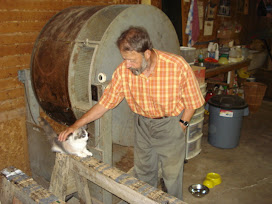
  1. My dad attentive to a creature
    A person who sparked my interest in science.  For me, that was my father. As a farmer, he cared about living things in the fields and barns. He also took me on many walks in the woods where he pointed out different trees and plants. Although he did not have much formal education, he had interesting facts to share about the past and present uses of each plant or tree.


2. An early experience with science. When I was in elementary school, we sometimes had special elective classes in the winter time. The elective that captured my attention was not my own, but my sister's. She was part of a small group led by an embryologist who taught at the University of Toronto. He led the students in creating individual science fair projects. My sister worked on hers at home. Her topic was "blue babies" and a life saving operation developed to make their hearts work properly. She made models of the heart out of blue and pink playdough, and I can still picture her display board.

3. A more recent experience with science. During the second COVID school lockdown I was also teaching science. One of the remote lessons I developed was for students to spend an hour outdoors and record all their observations of living and non-living things and their interactions. To provide a "sample" observation record, I spent time beside a storm pond close to my home. This experience stands out to me as a peaceful time of connection with nature and with God, during a turbulent period in history.

4. Recent interest. I shared with my students some things I had recently learned about the Great Lakes from an audiobook I had finished a couple of weeks earlier. The Death and Life of the Great Lakes by Dan Egan further developed my understanding of the effects of human innovations like industrialization, canals, waterways, sewage systems, and international trade on the five freshwater lakes at the border of Canada and the United States. The plants, fish and other living things in these lakes have been affected by pollution and invasive species. Living near the Great Lakes gives me a responsibility to know and care about their well being as a habitat.

Even if you are not a student, this post may give you time to reflect on your learning journey in science or some other area of study. People, events and experiences all contribute to our learning, and I am grateful for them.



Monday, 11 July 2022

Getting to Know the Trees


One of the legacies my father has left me is a knowledge of trees. He was neither an arborist nor a lumberjack nor a craftsman who worked extensively with wood. Rather, he was a farmer alert to the beauty around him in the natural world. When I was a young child, he started to teach me the unique traits of different trees as we walked along roads and trails, wherever we might be. I marvel at the diversity within the "mixed forest" ecosystem in which I live, where evergreens and deciduous trees live side by side.

I no longer live in a rural area, and I notice that students raised in the city have very limited vocabularies when it comes to trees. They know "bark" and "tree" and "pine cone" and "Christmas tree." Why might it be valuable to know the trees by name? 

When we see human beings just as "people" in general, we don't feel related to them much. Yet, those we've met and gotten to know by name are the ones we begin to care about and pay attention to. In the same way, knowing a birch, a spruce, a mulberry bush, and an oak focuses our attention on a particular tree as a thing of beauty. Each one brings something glorious into our lives--the story of Indigenous people and the ways they turned birches into canoes, the awareness that spruce wood is used in pianos and violins, the mulberries we can pick and sample in July, and the vast oak that provides shade from a blazing sun.

Some new trees I've gotten to know this summer are known either as the service berry or the Saskatoon berry or the June berry. They can be found as bushes or trees that grow to about three times the height of a human. They have a special place in Indigenous culture, as highlighted in this article by Robin Wall Kimmerer.  I noticed the berries on one of my neighbourhood walks; these trees had been planted by the city on the boulevards of a subdivision built perhaps 30 years ago. 


Other than the birds, nobody else seems to be interested in them. Now that I know the service berry, I pay attention to it and am grateful for it in a more specific way than just "Thank you, God, for making the trees." In my suburban setting, my walks and bike rides are enriched by knowing the trees I pass by, one at a time.

Tuesday, 3 January 2017

Guest Post by Carolyn: A Pregnant Opportunity

With a vision to having our students intentionally engage God’s world, locally and globally, every class at LHCS participates in a service project during the school year.  This opportunity is meaningful to the students and encourages them to selflessly think of the needs of others.
In November our Grade 6B class learned about an organization called Salama SHIELD Foundation.  Begun by Mrs. Fehderau’s brother, they operate in Uganda and Malawi, building relationships and learning the stories of those in deep need, in order to search for appropriate solutions.  The foundation has been able to improve the lives of tens of thousands through its programs in food security, micro-credit revolving loans, water, education, and health.  And goats!
The students were challenged to change a behaviour or attempt a new one that would educate them about living with less.  Some examples given were sleeping on the floor, wearing clothes that didn’t fit properly, or only using a bar of soap to wash everything with.  The students could choose the length of time during the month that they would perform their act.
In addition, Mrs. Mostert and Mrs. Fehderau encouraged the class to think of unique ways that they could fundraise for SALAMA Shield, in order to buy pregnant goats to be given to families in need of the milk and the potential income generated by selling the kids.  Each goat costs $75, and that amount became a goal for many of the children.
The grade sixes took to the challenges with enthusiasm!  “We are privileged to have so much”, one of the students said, so they sold some of their toys to raise money.  “We have it a lot easier”, noted another student, who chose to wash everything, even their hair, with a bar of soap for a few days.
“It was hard to wear clothes that didn’t fit properly, and I felt bad for people who have to all the time”, said one girl who wore her Dad’s shirt for a week.  Another student commented: “It hurt my back to sleep on the floor, and I learned that we are really blessed”.  “It was kind of annoying to drink only water for a week”, was an understandable observation made.  One of the teachers and one of the students wore the same clothes for a month!
Through selling chips, the sale of their own baked goods, extra jobs for parents, selling jewelry they made, and more, the class raised enough money to buy 28 goats!  It was a herculean effort that will richly reward those that Salama SHIELD will be able to help.  The month ended with a class party that included goat cheese and a thought provoking story called A Country Far Away, a book that ingeniously examines the differences between life in North America and life in Africa for a child.
One student’s comment sums up the experience well: “I didn’t realize how much a goat could help”.  These grade six students didn’t realize how much they could help either, but the Lord has blessed their efforts through this learning opportunity.

Saturday, 11 July 2015

Mythbusters: Fur Farm Edition

  Over the past couple of months two fur farms in Ontario, Canada were targeted by animal rights activists.  In the first incident on May 30th 2015 about 1500 adult mink were released from their cages. Then again this week over 6500 fur bearing animals that had been born earlier this spring were "freed" from a different farm.
   Several myths have been brought to the forefront by such activist groups, and without a knowledge of what actually goes on at a fur farm, the general public may be misled.

Myth #1 Fur Farmers only care about profit
   Fur farms in Ontario are often family-run operations that take years to build up in size.  While people think about fur coats as an expensive luxury, the amount of money a fur farmer earns is only a fraction of the final price of a garment.  If the farmer cared only about the amount of money he is earning, it would not be enough motivation for the long hours and up-front costs (food, vaccinations, infrastructure, and pens) required.  My parents were fur farmers for about fifty years; they genuinely cared for the well-being of their animals not just because the loss of an animal cut into their profits.  It was a way of life that entailed respect and up-close learning about the life cycle of one of God's creatures.

Myth #2 Raising an animal for its fur is wasteful
   At first glance, fur-bearing animals raised for their fur may appear to be like poaching elephants for their tusks or black bears for their gall bladders.  However, in the fur industry, every part of a mink or fox left after the pelt has been taken off is put to a use.  For example the oils are used in various cosmetics and waterproofing for leather footwear.  As well, the food that is prepared for farm-raised fur bearing animals to eat is not taken from the human food chain; rather meats and proteins that are undesirable or substandard for human consumption are being used in a productive way.

Myth #3 Farm animals would survive better in the wild
   When activists break open cages to release animals into the wild, they think the animals will be better off.  However, when such a large number of creatures is added to an ecosystem, the balance is upset. There will not be enough food to sustain them all; since the farm-raised animals have a place of warmth and shelter, placing them into the wild at certain seasons of the year is particularly perilous. For example, during the May 30th incident, nursing females were released, leaving their milk-dependent babies without warmth and nourishment.  The weather that night was also particularly cold, adding to the problem.
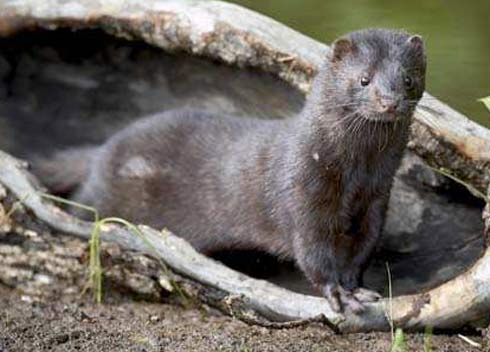
   A few times during my dad's farming career, people would phone him about a mink that was causing a nuisance on their property.  When he went to these places, he could tell immediately if the mink was farm-raised or wild.  The size alone is a significant difference, with wild mink being smaller.  Wild mink have to find their own food and face different predators, including great horned owls, coyotes and wolves (and other mink!).

   Even if some people do not agree with the raising of animals for their fur, they do not then have the right to damage private property and commit acts of vandalism like this.  By taking the law into their own hands, such activists discredit their cause.

Wednesday, 20 May 2015

Unbalanced

   I set a priority for myself to seek greater balance in my life when this year, 2015, began.  However, I have to say I have made only little progress in this pursuit. Most of it has come the hard way.
   Lack of balance, quite literally poor posture and lack of attention to the load my back and shoulders were regularly carrying, resulted in a neck strain.  Since our bodies are so interconnected, one of my arms started going numb, tingly and painful at regular intervals during the day.  This discomfort demanded that I address the imbalance.  Instead of carrying heavy bags which pull my shoulders forward, I now use a back pack or a cart to transport school books. With the help of a physiotherapist and her practical exercises, that area of imbalance is pretty much resolved.
Free range stock photo
   A second area of imbalance came from the bad habit of eating my lunch on the run whenever I was teaching.  When it doesn't fit into my schedule, I forget to eat lunch until after 3:00.   I could ignore my body's signals to eat, and I often forget to drink also.  That lack of care for my body's needs led me to develop a kidney stone in April.  I had heard reports about how painful a kidney stone can be; a few times I did cry because of the pain. Thankfully I only missed one day of work and managed with ibuprofen for pain until it passed seven days later.  Now I carry a water bottle and force myself to drink from it throughout the day.  I am trying to sit in the staff lounge with my snacks and lunch to restore balance, but it does not happen every day.
   I cannot blame anyone else for working me too hard; it is my driven personality that focuses on being "productive."  I did not learn this from my parents.  Growing up on a farm, lunch and breaks were always taken together as a family with Dad there too.  Conversation and fellowship were just as important as the Gouda cheese, sliced ham and home-made bread.  However, already then, part of me felt that an hour-long lunch was extravagant and that taking a nap would prevent all the work from being completed.  (I did not realize then how a nap gave my parents the stamina to keep going with the demands of a busy farm and busy kids.)
   I cannot blame my job for this lack of balance either.  It precedes my employment as a teacher.  In 2008 when I was a stay-at-home mom and occasional supply teacher, I entered a writing contest for my local newspaper.  As one of over a dozen chosen for a Community Editorial Board, I was required to write an opinion piece each quarter about an issue that had a local connection.  Due to my intensity and concern about having my writing be placed out there for the scrutiny of thousands of people, I developed a case of shingles around the time of my first deadline.  My husband sometimes reminds me of this incident when I am working too hard.
   My greatest ally in the desire to live a more balanced life has to be my husband.  He provides subtle accountability just by his gentle presence at home.  Because we try to have a time of devotions and prayer every night before bed, I don't stay up later than is good for me.  When I'm worried about something and can't sleep, he's never upset when I wake him up and ask for help.  He reminds me that I can't add more tasks to my life without subtracting something.  He encourages me to take breaks from computer work.

Monday, 18 August 2014

A Door to a New World

 
 The image of a door that opens to a new world and/or a new reality appears often in literature.  We have the wardrobe's door in the Narnia books, the door into the Secret Garden and the platform 9 3/4 in the Harry Potter books, just to name a few.  The word door has this association for most people, and at times when we speak of something being "five doors away", it includes the entire house or room that the door leads into.  When you read or hear the word door, you may have in mind the concept of a physical door (swings open and closed, has a knob or handle by which it can be opened, is able to be locked or unlocked, may contain a window, strong, sturdy).  Some people, who are visual thinkers, picture specific doors they have encountered in their lives whenever this word comes up, and it plays in their brains "like Google images" [1].  One such person is a woman named Temple Grandin.

   Ms. Grandin was born in Boston in 1947 and at a young age was diagnosed with autism.  She began speaking later than most children and had difficulty interacting with others socially.  If we consider autism to be enigmatic today, multiply that several times in the 50's and 60's when she grew up.  Despite obstacles, Grandin graduated from high school and college, earning both a Master's Degree (1975) and a Doctorate in Animal Science (1989).
   Something depicted well in the HBO Film Temple Grandin was the way in which her high school science teacher helped her conceptualize her future in college.  Dr. Carlock said to her:
        "Think of it as a door.  A door that is going to open up onto a whole new world for you.  And all you
        need to do is decide to go through it."
Several times in the film, Temple Grandin needs to go through a scary door to get to the new world she will become part of--from the frightening automatic door at the grocery store that reminds her of a guillotine to the door of a slaughterhouse she will ultimately redesign to be more humane and the cinematic door she walks through to speak publicly about autism at a national conference. 
   Temple Grandin is an individual who has been tremendously influential in the area of treatment of animals at slaughter facilities by using her visual mind and attention to detail.  As she heroically stepped through various doors, she also extended "the horizons of the possible" [2]  for many others.

[1] Temple Grandin. "The World Needs All Kinds of Minds" TED talk, 2010.
[2] Andy Crouch Culture Making (2008), pp. 17-36

Friday, 2 May 2014

Memories of Primavera

   Primavera is the word for spring used in countries whose languages originated from Latin.  In prima we hear the word "first", while vera refers to the opening up of flower buds.  The first flowers opening is just one sign of spring.  I'd like to share two memories of spring from my rural roots.
   When I was in seventh or eighth grade I would try to wake up early at this time of year (late April, early May) and go outside before eating breakfast.  I would head to the long barns housing the minks my dad raised, walk up and down the aisles and listen.  What was I listening for?  The sound of "peep, peep" that told me babies had been born in one more nest box. Each cage that housed a pregnant female had a stiff paper identification tag on it.  At the sign that the mother had given birth, these tags were moved to the top of the nest box, like a flag raised in triumph.  Before breakfast and before going to school, I wanted to be the one who discovered which females had given birth overnight.  After supper, I also loved the ritual of going around with my dad and recording in our notebook how many litters had come in that day, and how the herd was progressing in this "whelping season."  As the month of May progressed, the barns were filled with a unique spring chorus.
Day-old mink kits--blind and virtually hairless but able to say, "peep, peep"
   During another part of my life, when I lived on the site of a greenhouse operation, another spring memory involved a particular smell.  A fraction of the rose bushes in the greenhouse operation were pulled out each spring and replaced with new plants.  But prior to planting the new ones, the soil had to be steamed.  In this way it would be free of weed seeds and germs that might threaten the new growth.  The smell inside the greenhouse when the soil was being steamed is hard to describe, but my husband used to call it "cooked dirt."  If you literally baked a mud pie in your home oven, you might be able to relate to that smell.  Soon after planting the red shoots would quickly emerge.  I would take my toddlers out to watch the progress of the new plants, as the goal was to be able to harvest long stemmed roses by Mother's Day.

   Sometimes I miss these rural moments that defined my spring in days gone by.  My children are farther removed from the realities of the creatures that give birth in spring time and the farmer's field going from barren brown to lush green.  That's why making time for a walk in the woods, a trip to a family farm and taking the scenic route is so important to all of us.

Monday, 3 March 2014

When It's not about you

   It takes a measure of faith to believe in God’s providence.  It is possible to dismiss the everyday positive happenings as coincidence or luck.  And when things go horribly wrong in our lives, it is hard to see a caring God or to trust that in the end it will be for the best.  Often the only way to see God’s providence is by looking back, years after a painful event.  I’d like to share one story like that.
   During the summer of 1988 I spent part of my summer in Michigan leading Vacation Bible School and otherwise assisting a church with outreach.  While I was away from home my family was going through a particularly stressful time such that my father had to be hospitalized.  The reasons for the stress concerned a business partnership that had gone awry despite the best of intentions at the beginning.  My father’s hospital stay caused hardship to my family because of the separation and the need to manage a farm during the busiest season of the year.  As the eldest child in the family, I was unable to help from a distance.
   My father’s response to being in the hospital led us to being able to see God’s providence in the situation, however.  He was looking out for the other patients and seeing how he could help them.  He was drawn to talk with one woman in particular.  Vera, like my father, was born in the Netherlands.  She was alone in the world and was suffering from major depression.  She was estranged from her husband, and she would have no place to go upon release.  Her only relatives lived overseas.  When my mother went to visit, she was introduced to Vera in the pleasant meeting area provided.  My parents’ hearts went out to her.
   Not really knowing how things would unfold, my parents agreed that Vera could come home with them when my father was released.  Vera walked around my parents’ spacious acreage, ate with the family and appreciated the privacy of the guest room she had been given.  However, it seemed that God knew my parents had enough to handle.  An aunt and uncle from the Ottawa area were also visiting and they felt compelled to give Vera a new start at their home.
   Vera lived with them for a period of time and was able to find work.  Through my aunt and uncle, they were able to make contact with her family in the Netherlands.  In the end an arrangement was made for her to go back to Holland and be cared for by her relatives.  If it were not for the misery my family went through, my parents would never have been involved in helping Vera’s life move forward.
   Sometimes circumstances place us where we would not choose to go.  At such a time, the purpose of our being there may not be about us at all.  It may be for the benefit of someone else entirely.  Eyes of faith must overcome our natural tendency for self-pity.  God has a bigger plan than we can imagine, and we need to trust Him.

   It causes me to think about the imprisonment of Christians in many places around the world.  Prison is the last place a person chooses to go, but many faithful Christians who have been placed there by the evil intents of a corrupt regime make the most of their time.  They determine to live out their faith for the benefit of the hardened criminals and guards who might not otherwise hear the gospel of salvation.

Monday, 24 February 2014

A Christian Response to Hunger Since 1983[1]

   Each week the church I attend takes an offering for needs in the community or the world at large.  Next Sunday is the time for the annual gift for the Canadian Foodgrains Bank, a cause that is one of my favourites for four reasons:
  1. The Canadian Foodgrains Bank is one beacon of the way Christians of various denominations can work together.  Fifteen national church bodies, Protestant and Catholic, evangelical and mainline, rural and urban, are demonstrating that partnering for the benefit of the world’s hungry people makes a huge difference.
  2. The donations made by Canadian citizens are matched by the Canadian government through Foreign Affairs, Trade and Development Canada (formerly known as CIDA).  Not only that, in the the thirty plus years of its existence the Canadian Foodgrains Bank (CFGB) has influenced government policy to “untie” the food aid it gives.  Up until 2004 aid from the Canadian government came with the stipulation that it had to be purchased from Canadian farmers and then shipped to the area of need.  Due to the persuasion of CFGB and its supporters, that policy has been changed so that people facing disasters can be given food grown as local to them as possible.  This speeds up the response and supports farmers in the developing world at the same time.
  3. CFGB is not just about feeding people in a time of famine, war or natural disaster.  It also provides training in agricultural techniques that are based on naturally conserving the fertility of the soil, sustainable irrigation systems and better yields from small spaces.  When appropriate this organization works with the communities to set up infrastructure programs.  In exchange for the labour of the local people, the workers are paid in food rather than currency.  This gives dignity to a person in need because the food is not simply a hand-out.
  4. As a bank, this organization keeps some of its funds in reserve so that when a disaster occurs it can respond immediately.  It will appeal to donors, but it does not need to wait for them in order to get started.  I have confidence in the way CFGB delivers aid to hungry people, from Syrian refugees to subsistence farmers in Nicaragua and beyond.
    Woman receiving food aid in Niger in 2012, from CFGB photo gallery
Please share what your favourite charity is and why.


[1] This is the tag line of the Canadian Foodgrains Bank.  Its website is www.foodgrainsbank.ca

Monday, 16 December 2013

Walk-in Cooler Stories

When this knob is pushed from the inside, the door opens.
Last Friday I spent the first part of my day volunteering at a food hamper program where my husband is employed full-time.  The first job I was assigned was sorting donations of yogurt by their “best before” dates.  The idea is to hand out yogurt that is getting close to this date and save the freshest yogurt for later.  Since these dairy products are perishable, my work space was a walk-in cooler.  Wearing my coat, hat and gloves, I went through numerous plastic totes to organize every brand, flavour and container size of yogurt imaginable.
   Being inside the walk-in cooler with the door latched did not bother me at all because there was an inside-release knob that I could press to exit whenever I needed a break.  It reminded me of a time my father had a similar experience, except without the inside-release knob.
   It was a late December afternoon at our mink farm.  Our walk-in cooler was used to refrigerate the meaty feed which was given to our animals, but in December the thermostat was set to freezing to store pelts that needed processing at a later date.  This particular Sunday my dad went out to check something inside the cooler/freezer when a gust of wind slammed the door shut.  Fortunately there was a light switch inside, but to his dismay the (removable) inside-release knob was hanging somewhere OUTSIDE of the cooler.  My dad was stuck inside with no way to get out.
   He gathered his wits and immediately turned the thermostat up from the freezing mark.  He assured himself that after the family had finished watching the hour-long program “The Wonderful World of Disney,” they would come looking for him. 

   Warm inside our house my sister, mother and I were oblivious to what was going on.  I was the one sent out to look for Dad, no doubt complaining about all the gear I needed to put on.  As I approached various outbuildings I must have called out his name, until I heard a muffled voice from inside the well-insulated cooler.  When I opened the heavy door, he was so glad to see me.  He was hoarse from yelling but otherwise unharmed.  From that day forward, the inside-release knob was kept where it belonged.

Wednesday, 28 August 2013

Bumblebees

This summer my husband and I have been learning more about bumblebees.  A nest underneath our front step means that when we sit there, we can observe their noiseless take offs.  We can also watch their deft landings, which are accompanied by a glimpse of the load of yellow pollen on hind legs.
   We cannot actually see the nest, but judging by the amount of activity during the day time, it is a full-size colony of at least 50 bees.[1]  Our front garden, adjacent to our front step, contains a few vegetable plants, but the plant nearest the step is producing the most beans.  We wonder if we should thank our fuzzy boarders for that.  Although bumblebees collect nectar and pollen and thus contribute to pollination of crops, they make only enough honey to feed their young.  Unlike honeybees, bumblebee hives do not survive the winter but start over again each spring with a queen that has hibernated on her own.
   Taking the time to closely observe the little creatures of our world can help us grow in appreciation for their Designer.  Basil the Great (330-379), who was a church bishop in Caesarea is quoted as having said, "If you speak of a fly, a gnat, or a bee, your conversation will be a sort of demonstration of His power whose hand formed them; for the wisdom of the workman is commonly perceived in that which is of little size." 


[1] According to www.kentbee.com, it is rare for a colony to grow beyond 70 individuals

Friday, 2 August 2013

Three Days of Rural Life

In each issue of the monthly magazine entitled Country Woman the editor Ann Kaiser writes about her visit to a farm of one of her subscribers.  She does not just describe the scenery or give production statistics, she works alongside the farm owners and gets her hands dirty.  Through her stories, the readers become more familiar with a variety of different types of farming, from livestock to food crops.
   I just returned from a three-day visit to a farm where my sister and her husband began raising mink about two years ago.  A mink is a small carnivore prized for its fur coat.  I should say that visiting a mink farm was not a totally new experience for me.  I grew up at the same property, where my parents raised mink until 2006. 
   This time I did not go just to enjoy the vistas and the quiet evenings.  I went there in order to work.  I was part of an incredible team that caught and vaccinated all of their animals over two-and-a-half days.  Catching a mink is no small feat.  First, the catcher wears thick leather gloves to avoid being bitten.  The animal is frightened, so it squeals and squirms.  It also releases a musky odour that sticks to your hair and clothing.  My sister and her husband were the two catchers, and they had incredible stamina.  Compared to their job, mine was easy.  I wore a lab coat and acted as the veterinarian, giving each mink a dose of vaccine. Other important team members contributed by doing assorted helpful jobs, such as opening cages and troubleshooting when the needle was not working properly.
   In reflecting on these days I realized anew that farming is not a profession for the lazy.  Even though pieces of equipment help make some of the work easier, there seem to be just as many tasks to fill the day from early morning until quitting time around 6:00 pm.  The summer season is one of great intensity, and yet these farmers persevere.  It is honest and satisfying labour; it is work that allows you to see your progress, most of the time.  I’m so proud of my brother-in-law and my sister as they continue this farming endeavour.