Popular Posts

Showing posts with label music. Show all posts

Tuesday, 3 January 2017

Looking Back upon "Jubilee"


One year ago I chose the word "Jubilee" to give shape to my experiences for 2016.  I wanted to be more conscious of issues related to justice and to celebrate things worthy of jubilation.  Looking back on 2016, the following items connect to the theme of Jubilee:
  • In 2016 I celebrated with three loved ones as they graduated from one level of schooling to another.  Two earned their high school diplomas, and one her Grade 8 diploma.
  • Jubilee was experienced through music.  In 2016 I had the opportunity to experience the 40th anniversary concert for the Ontario Christian Highschool Choir Festival in the spring and a rousing orchestral and choral rendition of Handel's Messiah just before Christmas.
  • Musical theatre was also a cause for jubilation.  Each of the five live plays I was privileged to experience combined story telling with song: The Pirates of Penzance; The Lion, the Witch and the Wardrobe; Our Town; Charles Dickens Writes A Christmas Carol; and Christmas in Reverse.
  • I learned more about global justice initiatives through reading The Locust Effect by Gary Hausen and Clay Water Brick by Jessica Jackley.  My husband and I were able to support new charities that are focused on bringing justice to the marginalized.
  • The schools I am affiliated with began celebrating milestones in 2016: the high school marked 40 years of God's faithfulness and the elementary school is commemorating 50 years, a true jubilee.
  • My father had successful surgery to improve his mobility and reduce back and neck pain.  My mother had a cataract removed and can see more clearly. The support both my parents received from the medical community and their church family has also been cause for jubilee.

Thursday, 14 May 2015

Not a Waste: the Short Life of Arthur Gullidge

Freerange stock photo
   When we hear about massive loss of life, we are often affected.  However, it can quickly become just a statistic for us.  A character in a 1932 essay by pacific Kurt Tucholsky says, "The war? I cannot find it to be so bad! The death of one man: this is a catastrophe. Hundreds of thousands of deaths: that is a statistic!"  Tucholsky himself was a pacifist, but he put these words in the mouth of a French diplomat to show the irony of human response to mass deaths. (This quotation is often attributed to Russian dictator Joseph Stalin, but he was probably just repeating or rephrasing the above.) [1] 
   The South Pacific portion of World War II is less known to me as a Canadian with European ties, but I recently learned how a Japanese ship called the Montevideo Maru was torpedoed by an American submarine in July, 1942 killing 1,053 prisoners of war being transported.  This is surely a sad statistic; those being held in the cargo hold of this ship were allies of the Americans, yet they perished at their hands.  However, every one of those who died in that ship had a story.  I'd like to share just one of them with you.
   Arthur Gullidge was an Australian man with a gift for music.  At a young age he joined the Salvation Army in the city of Brunswick and became part of the music ministry that this Christian denomination is known for: its brass band.  Not only did he play music, but he also conducted and composed band music.  His first work was published when he was just seventeen years of age.  He won awards and published music under his own name and a pen name of Greendale.  When the war broke out Gullidge struggled with the feeling that he ought to contribute in some way that befit his Christian faith.  He became the leader of the 2/22nd military band, which formed when 26 Salvation Army band members enlisted together with intents to serve as stretcher bearers when the need would arise.
   Gullidge and the others were deployed to a military post called Rabaul on the tip of one of New Guinea's islands.  After Pearl Harbour was attacked in 1941 and the Japanese advanced forcefully, it was only a matter of time before Rabaul would be taken.  The soldiers who had been sent there were told to stay.  After they were captured, these soldiers and civilians were taken by the Japanese ship in order to become slave labourers in Korea, Japan or one of its territories.  The sinking of the Montevideo Maru was not reported to the people of Australia until after the war had ended.  The outpouring of grief was immense, especially for the Salvation Army presence there.
   One of Gullidge's best known band pieces called "Divine Communion" was played at a concert I recently attended in Guelph, Ontario.  The conductor Al Hicks had not planned to come up and introduce the piece, but in doing so he told the audience the story of its composer.  Without his lead-in, I would never have written this post. When the words to the band music were projected on the screens, these ones were all the more poignant:
All there is of me, Lord
All there is of me, Lord 
Time and talents, day by day,
All I bring to Thee;
All there is of me, Lord
On thine altar here I lay
All there is of me.
   It is clear from these lyrics that Gullidge's life was built upon submission to God's will.  This testimony speaks to us today and show that even though he died young it was not in vain.

  [1] Eoin O'Carroll explains this in the Christian Science Monitor article entitled "Political Misquotes: the 10 most famous things never actually said" dated June 3, 2011.

Saturday, 15 November 2014

Providential Songs

  Providence does not always involve something physical, like food or clothing.  The greatest incidents of providence in our lives may be when a word of comfort comes to us that we really need at that moment.  It may come through a Scripture passage, the words of a friend or the words of a song.

I Lift My Hands

   When my sister’s husband was in the hospital due to a serious accident, a certain Christian song by Chris Tomlin seemed to be playing whenever she was driving to visit him.  It seemed as though the words were aimed exactly at her need.  The first part of “I Lift My Hands” goes like this:


Be still, there is a healer
His love is deeper than the sea
His mercy, it is unfailing
His arms are a fortress for the weak

Let faith arise
Let faith arise

I lift my hands to believe again
You are my refuge, You are my strength
As I pour out my heart, these things I remember
You are faithful, God, forever

Cry out to Jesus

   Another true story of an occasion when a song spoke just the words a person needed to hear is explained in Third Day's song "I Need a Miracle." A man in desperation planned to take his own life, but a song on the radio made all the difference.  The elderly parents of the man who experienced this incident came to a Third Day concert and told the band members that it was, in fact, their song "Cry out to Jesus" that God used to bring comfort and new hope to their son.

He lost his job and all he had in the fall of '09
Now he feared the worst, that he would lose his children and his wife
So he drove down deep into the woods and thought he'd end it all
And prayed, "Lord above, I need a miracle"

...

He turned on the radio to hear a song for the last time
He didn't know what he was looking for, or even what he'd find
The song he heard gave him hope and strength to carry on
And on that night they found a miracle
They found a miracle

How Firm a Foundation

   Finally, a song that touched me when I was at an evening church service during college was "How Firm a Foundation."  I found that I could not really get out the words because at that moment the words were as the voice of God speaking directly to my heart.  It dealt personally with a struggle I was having about whether God was really enough and how much he really cared.

How firm a foundation, you saints of the Lord,
Is laid for your faith in his excellent Word!
What more can He say than to you He has said,
To you who for refuge to Jesus have fled?

"When through the deep waters I call you to go,
The rivers of sorrow shall not overflow,
For I will be with you in trouble to bless
And sanctify to you your deepest distress."

Is there a song that has particularly touched you when you most needed it?  Please leave a comment.  

Friday, 19 September 2014

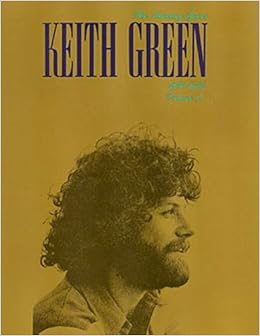
Not A Waste: The Short Life of Keith Green

Cover of songbook
   Keith Green was born in 1953 in New York City; from a very early age he showed much musical promise.  He had perfect pitch at the age of two, could play the ukulele at age five, played guitar and piano, wrote his own songs and signed a recording contract when he was just eleven years old.
   In those days record companies did not know how to market young musicians, and this led to some disappointment for Keith as a teenager.  He ran away from home and explored all kinds of spiritual avenues to make sense of life.
   In 1975, he embraced faith in Jesus Christ and began writing music to reflect this new beginning in his life.  His passionate plea to whomever was in the audience was to live for God wholeheartedly. In the years following his conversion, Keith Green released five albums.  He was not interested in making money but gave away his music and made his concerts free (a free will offering was taken). That attitude of ministry included opening his home to people trying to turn their lives around such that it was nicknamed "the Greenhouse," a protected place where growth could occur.  Along with his wife, they also produced literature and began an organization called Last Days Ministries.
   Keith Green's life on this earth was brought to a sudden halt by a plane crash in 1982, which also claimed the lives of two of his children.  He was only 28 years old at the time.
   Although he died over thirty years ago, his influence lives on and many of his words remain prophetic.  Even then, some of the music known as "Christian contemporary" did not seem to line up with Jesus' way of doing things.  I leave for your consideration a paragraph from a pamphlet he wrote entitled "Can God Use Rock Music?":

    It isn't the beat that offends me, nor the volume - It's the spirit. It's the "Look at me!" attitude I have seen in concert after concert, and the "Can't you see we're as good as the world?" syndrome I have heard on record after record. Jesus doesn't want us to be as good as the world, He wants us to be better! And that doesn't mean excelling them in sound, style, or talent - it means surpassing them in value - in our motives for being up there on stage, in our reasons for singing our songs, and especially in who we're singing for! If there's anything wrong or worldly at all about so-called "Christian rock," it's the self-exalting spirit and attitude that comes across so loud and clear in many of the records and concerts today.  [1]

   Keith Green's example of humility and the plainspoken message remains a model of what music ministry ought to be.  

Saturday, 26 April 2014

Recycled Orchestra: Music from the Soul

   Last night I was privileged to hear youths from Paraguay perform orchestral pieces on instruments made from items reclaimed from the landfill of its capital city, Asuncion.  The "Recycled Orchestra" from the slum of Cateura actually boasts 160 members, but just 16 are taking part in this Canadian tour.
   I first read about the ingenuity of this orchestra through an associated press article in December 2012.  I was so inspired that I kept it.  The orchestra is the brain child of its conductor, Fabio Chavez, a music teacher and social worker.  At first, he had only five instruments to share among the many interested youngsters.  Then, he recruited Tito Romero and Nicolas Gomez to build brass, woodwind and stringed instruments out of the resources brought to the city dump.  I testify that the sounds these instruments produce are as authentic as they are unique.
   As the conductor allowed various students to introduce themselves and their instruments, the audience was told which raw materials went into each one.  A 30 litre can that used to contain vegetable oil forms the body of the cello, while the downspout of an eaves trough, assorted buttons, handles of metal spoons and guarani coins became an alto-saxophone.
Photo of cello and player courtesy of Rebecca Bertrand

Close up of saxophone courtesy of Rebecca Bertrand

   The music performed by this ensemble included Frank Sinatra, the Beatles, Henry Mancini and Pachelbel. The conductor, who used head, lip and eye gestures to direct his orchestra, accompanied them on his metal-based guitar (see bottom of next photo).  The concert was closed by traditional music from Brazil, Argentina, Paraguay and Bolivia.
 
Foreground: Fabio Chavez, conductor, and 15 year-old player of the upright bass.  Photo credit: Rebecca Bertrand.
 
  Mr. Chavez shared many jokes and insights through a translator, but one thing he said sticks with me.  He said, "Talent is evenly distributed among humanity, but opportunity is not."  When the audience was invited to contribute an offering instead of an admission fee, they were helping to extend opportunity to the youth in the Cateura slum to have a better future than their parents, who work in the toxic environment of the landfill site.