Popular Posts

Showing posts with label not a waste. Show all posts

Friday, 1 November 2024

Not a Waste: The Short Life of Joseph Merrick

 In 2014-2015, I wrote a series of nine posts about ten individuals who had short life spans but who ought to be remembered for more than the fact that they died young. Each life has a purpose, and with that, I will bring another person to our remembrance. Joseph Carey Merrick lived 27 years, from 1862 to 1890, in Europe.

We have much to learn from the life of Joseph Merrick, though you may never have heard his name. He is better known for an epithet that compared him to an animal, but I will not mention it in this short biography [1]. Joseph had a physical disability that manifested during his days as a five year old boy; it changed the appearance of his skin and affected the structure of his bones, breathing and speech. After his mother died, none of his relatives was invested in his well being. As a result, Joseph ended up in a workhouse. Later, people exploited him and placed him on exhibit at carnivals in Europe. He was mistreated by his handlers to the point that Joseph lost self-esteem and his health became severely compromised. He thought this degraded life was all he could hope for.

According to the records left by Dr. Frederick Treves, Joseph began to receive treatment at the London Hospital in 1886. At this time, by talking with Joseph, the doctor discovered that he could speak and read. Furthermore, he could recite Psalm 23 from memory, having read it from the Book of Common Prayer. He was polite and loved to learn. A remarkable part of Joseph's story is that his mother (who gave him the middle name Carey after the pioneering missionary to India named William Carey) gave him a foundation of faith and taught him to love Jesus. Joseph continued to practice his faith once he was out of the clutches of hawkers.

After years of misery experienced by Joseph due to the cruelty of humans, some people of goodwill ensured that his remaining years would be comfortable. They also made it possible for Joseph to have a safe apartment within the hospital, to experience social interactions and outings, and to have opportunities for craftsmanship (basket weaving and making paper models of buildings). 

Joseph Merrick was created in the image of God, but those who only looked on the outward appearence made him out to be a monster. The Victorian era is associated with church going and traditional beliefs, but examples of the dehumanization of people who did not fit the categories of "normal" span the British Empire. Such "others" were given degrading names and were treated as subhuman. 

Learning of the story of Joseph Merrick has led to my own soul searching. I leave you with this question: How do we (people who say we love Jesus) still dehumanize certain individuals and groups of people today because we don't take the time to talk to them or understand them? 


[1] Through a simple internet search, you can find the name of a film about Joseph Merrick's experiences and the book by Frederick Treves, on which it was based.


Thursday, 14 May 2015

Not a Waste: the Short Life of Arthur Gullidge

Freerange stock photo
   When we hear about massive loss of life, we are often affected.  However, it can quickly become just a statistic for us.  A character in a 1932 essay by pacific Kurt Tucholsky says, "The war? I cannot find it to be so bad! The death of one man: this is a catastrophe. Hundreds of thousands of deaths: that is a statistic!"  Tucholsky himself was a pacifist, but he put these words in the mouth of a French diplomat to show the irony of human response to mass deaths. (This quotation is often attributed to Russian dictator Joseph Stalin, but he was probably just repeating or rephrasing the above.) [1] 
   The South Pacific portion of World War II is less known to me as a Canadian with European ties, but I recently learned how a Japanese ship called the Montevideo Maru was torpedoed by an American submarine in July, 1942 killing 1,053 prisoners of war being transported.  This is surely a sad statistic; those being held in the cargo hold of this ship were allies of the Americans, yet they perished at their hands.  However, every one of those who died in that ship had a story.  I'd like to share just one of them with you.
   Arthur Gullidge was an Australian man with a gift for music.  At a young age he joined the Salvation Army in the city of Brunswick and became part of the music ministry that this Christian denomination is known for: its brass band.  Not only did he play music, but he also conducted and composed band music.  His first work was published when he was just seventeen years of age.  He won awards and published music under his own name and a pen name of Greendale.  When the war broke out Gullidge struggled with the feeling that he ought to contribute in some way that befit his Christian faith.  He became the leader of the 2/22nd military band, which formed when 26 Salvation Army band members enlisted together with intents to serve as stretcher bearers when the need would arise.
   Gullidge and the others were deployed to a military post called Rabaul on the tip of one of New Guinea's islands.  After Pearl Harbour was attacked in 1941 and the Japanese advanced forcefully, it was only a matter of time before Rabaul would be taken.  The soldiers who had been sent there were told to stay.  After they were captured, these soldiers and civilians were taken by the Japanese ship in order to become slave labourers in Korea, Japan or one of its territories.  The sinking of the Montevideo Maru was not reported to the people of Australia until after the war had ended.  The outpouring of grief was immense, especially for the Salvation Army presence there.
   One of Gullidge's best known band pieces called "Divine Communion" was played at a concert I recently attended in Guelph, Ontario.  The conductor Al Hicks had not planned to come up and introduce the piece, but in doing so he told the audience the story of its composer.  Without his lead-in, I would never have written this post. When the words to the band music were projected on the screens, these ones were all the more poignant:
All there is of me, Lord
All there is of me, Lord 
Time and talents, day by day,
All I bring to Thee;
All there is of me, Lord
On thine altar here I lay
All there is of me.
   It is clear from these lyrics that Gullidge's life was built upon submission to God's will.  This testimony speaks to us today and show that even though he died young it was not in vain.

  [1] Eoin O'Carroll explains this in the Christian Science Monitor article entitled "Political Misquotes: the 10 most famous things never actually said" dated June 3, 2011.

Tuesday, 24 March 2015

Not a Waste: the Short Life of Blaise Pascal

   It has been about six months since I last wrote a short biography in this series.  Researching the life of Blaise Pascal (1623-1662) was more formidable than I expected.  He lived during a tumultuous era in France when kings and cardinals were both rising in power. Since the king cared about religion, and the religious leaders who advised him cared about power, there were bound to be some compromises.

 
   The life of Blaise Pascal was full of seeming contrasts.  He was a mathematical genius who never attended school.  He embraced a lively faith in God at a time when the "wise men" of his time were dispensing with the supernatural entirely.  While Pascal was firmly devoted to the Roman Catholic Church, he wrote a series of anonymous open letters defending beliefs about grace and free will that were being denounced by influential Jesuit priests and the Pope himself as "crypto-Calvinist" [1].  He struggled with illness and weakness throughout his short life of 39 years; however, he refused to give in to self-pity.  One example of his focus on others and their needs was that he invited a homeless family to live in his house with him during his final months.
   Blaise Pascal was home schooled by his father Étienne, who recognized the boy's academic brilliance from the time he could speak.  Originally the elder Pascal was going to wait until Blaise was 16 years old before teaching him any formal mathematics. However, when the 12 year old  showed an interest in geometry and then figured out on his own that the angles of any triangle add up to 180 degrees, his father changed the curriculum to include math after all.  At the age of 21, Pascal invented a calculator that could add, subtract, multiply and divide up to eight-digit numbers.  He saw the practical value of an adding machine to save the tiresome work of tax collectors and landlords. Although scholars agree about Pascal's genius, it was matched with perseverance.  He made fifty prototypes of his "pascaline" before he was satisfied enough to present it to the public.  He also did thorough investigations about vacuums and added to the branch of math we call calculus.
   Blaise Pascal is a delightful example of a person was intellectually gifted and yet recognized the limits of reason. His experience of Jesus Christ came via being immersed in Old and New Testament Scripture and the church fathers, including St. Augustine.  He had two distinct experiences one might call conversions--times when he had a memorable encounter with God that led to a change in his focus--one at age 23 and the second at age 31.  He rejected a faith that was merely academic, and he criticized the Jesuit order for becoming so worldly that it could justify moral practices clearly forbidden in the Bible.  Ambitious to the end, Pascal desired to write a work elevating vibrant faith in the eyes of the well educated and moral men of his day.  These incomplete bits and fragments were published after his death under the name of Pensées (Thoughts).
   One of Pascal's works, a "Prayer to ask God to make good use of sickness," I quote here in part.  It demonstrates his submission to God and acknowledgment that He determines our life span and the ultimate value of our work:
Lord, whose spirit is so good and so sweet in all things, and who are so merciful that not only the blessings but also the misfortunes that come upon your elect are the fruit of your mercy, grant me the grace not to question as a heathen might the state to which your justice has reduced me.  You gave me health so that I might serve you, and I made a wholly profane use of it.  Now you send me sickness in order to correct me; do not allow me to use this as an excuse to irritate you by my impatience....And since the corruption of my nature is so profound that it spoils even your favors, see to it, oh my God, that your all-powerful grace makes your chastisement salutary for me.  See to it, oh my God, that I worship in silence your adorable providence upon the conduct of my life; that your scourges console me; and that, having lived undisturbed in the bitterness of my sins, I taste the heavenly sweetness of your grace during the beneficial illness with which you have afflicted me.
---------------------------------------------------------------------------------------------------------------

[1] Blaise Pascal: Reasons of the Heart by Marvin C. O'Connell.  Published in Grand Rapids by Eerdmans in 1997, page 146. The doctrine under debate was related to a published work by Bishop Cornelius Jansen (1510-1576) entitled Augustinus, which highlighted St. Augustine's ideas of grace. It led some Roman Catholics to be worried about the spread of what they saw as a Protestant idea. Jansenism, as it was called, was firmly rejected in France in 1661 when all priests, nuns and monks had to sign a statement condemning it or be stripped of their office.

Friday, 19 September 2014

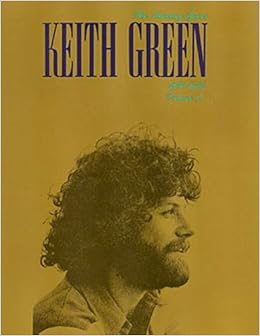
Not A Waste: The Short Life of Keith Green

Cover of songbook
   Keith Green was born in 1953 in New York City; from a very early age he showed much musical promise.  He had perfect pitch at the age of two, could play the ukulele at age five, played guitar and piano, wrote his own songs and signed a recording contract when he was just eleven years old.
   In those days record companies did not know how to market young musicians, and this led to some disappointment for Keith as a teenager.  He ran away from home and explored all kinds of spiritual avenues to make sense of life.
   In 1975, he embraced faith in Jesus Christ and began writing music to reflect this new beginning in his life.  His passionate plea to whomever was in the audience was to live for God wholeheartedly. In the years following his conversion, Keith Green released five albums.  He was not interested in making money but gave away his music and made his concerts free (a free will offering was taken). That attitude of ministry included opening his home to people trying to turn their lives around such that it was nicknamed "the Greenhouse," a protected place where growth could occur.  Along with his wife, they also produced literature and began an organization called Last Days Ministries.
   Keith Green's life on this earth was brought to a sudden halt by a plane crash in 1982, which also claimed the lives of two of his children.  He was only 28 years old at the time.
   Although he died over thirty years ago, his influence lives on and many of his words remain prophetic.  Even then, some of the music known as "Christian contemporary" did not seem to line up with Jesus' way of doing things.  I leave for your consideration a paragraph from a pamphlet he wrote entitled "Can God Use Rock Music?":

    It isn't the beat that offends me, nor the volume - It's the spirit. It's the "Look at me!" attitude I have seen in concert after concert, and the "Can't you see we're as good as the world?" syndrome I have heard on record after record. Jesus doesn't want us to be as good as the world, He wants us to be better! And that doesn't mean excelling them in sound, style, or talent - it means surpassing them in value - in our motives for being up there on stage, in our reasons for singing our songs, and especially in who we're singing for! If there's anything wrong or worldly at all about so-called "Christian rock," it's the self-exalting spirit and attitude that comes across so loud and clear in many of the records and concerts today.  [1]

   Keith Green's example of humility and the plainspoken message remains a model of what music ministry ought to be.  

Wednesday, 16 July 2014

Not a Waste: Parallel Lives of Eric Liddell and Dietrich Bonhoeffer

   I'm probably not the first person to notice some striking similiarities between two men of honour born just after the turn of the century who also passed  away within two months of each other in the year 1945.  These men are Eric Liddell and Dietrich Bonhoeffer. I will begin with a short summary of each man's life and then point out the common strands I observed while reading about them.
   Eric Liddell was born on January 16, 1902 to Scottish missionaries living in China.  His education from a young age took place with his brother at British boarding schools far away from his parents and sister, who continued to live and minister to the Chinese people.  Family visits took place infrequently during furloughs. Young Eric was not terribly academic, but he enjoyed the sport of rugby and running races.  In 1924, the eighth modern Olympic games were held in Paris, France, and Liddell was one of the members of the British team.  His best event would have been the 100 metre sprint, but when it became known six months before the event that the qualifying races would take place on Sunday, Liddell determined not to run. Instead he trained for the 200 metre and the 400 metre events, which would not require competing on the Lord's Day. After all of the celebrity that came through his gold medal performance in the 400 metre race, Eric Liddell remained humble.  He desired to use his athletic ability to connect people with spiritual truths.  He eventually went to various towns and regions in China to teach, preach, and provide basic medical care to its people. When World War II broke out,  Liddell made sure his wife and three young daughters were sent to safety in the West.  As the Japanese took over portions of China, they began to intern all Westerners.  Even in a concentration camp, Eric Liddell acted as a leader in organizing the internees and keeping up morale through sports, performing arts (plays were put on) and worship services.  With minimal food rations he kept up an incredible pace of service until it became apparent that he was burnt out.  He apparently had a brain tumour, which led to a fatal stroke on February 21, 1945.  He was 43 years old. [1]
   Dietrich Bonhoeffer was born on February 4, 1906 in Breslau, Germany.  Even though his family was not overly religious, young Dietrich (who was educated through home schooling and grammar school) decided to become a theologian at the age of 14.  He was gifted academically and attended different universities in Germany, writing two dissertations to become qualified as a professor.  When Adolf Hitler rose to power, Bonhoeffer was one of few German Lutherans to raise objections.  As early as 1933 he spoke out publicly against the tactics of the Fuhrer and had his radio broadcast suddenly cut in mid-stream.  Bonhoeffer continued to stand up for Jews and others persecuted by the Nazi regime, and his movements were being monitored.  When he was given the opportunity to live safely in the United States, he thought better of it and returned to his homeland.  He was arrested in 1943. After a time in prison, he was moved to various concentration camps (Buchenwald, two others and finally Flossenburg).  Here he was executed by hanging on April 9, 1945, at the age of 39. [2]
  
    In which ways did these men live parallel lives?
  • They were both men of principle and integrity, even when it was costly to their worldly successes.
  • They both wrote books about a life devoted to Jesus Christ.  Bonhoeffer wrote The Cost of Discipleship in 1937, while Eric Liddell's Disciplines of the Christian Life was published after his death.
  • Each of these men had tremendous gifts, which were developed and harnessed for the furthering of God's Kingdom in the places where they lived.  Their gifts were not used to gain status in the eyes of the world but to draw people to the Truth.
  • Both of them endured suffering for righteousness' sake and both spent time in concentration camps half a world apart.
   I wonder if these two men ever had the opportunity to meet each other during their brief lives on this earth. They certainly would have understood each other as brothers in Christ.  I can imagine each one of them saying, like Saint Paul, "Follow my example, as I follow the example of Christ" (I Corinthians 11:1, NIV).

[1] An easy-to-read biography of Eric Liddell with the same title was written by Ellen Caughey in 2000.
[2] An exhaustive biography of Dietrich Bonhoeffer is Bonhoeffer: Pastor, Martyr, Prophet, Spy by Eric Metaxas, 2010.

Wednesday, 4 June 2014

Not a Waste: the Short Life of Catherine of Siena

The lily is associated with Catherine of Siena
   This installment in a series I began in January comes with more reservations than I had in the other biographies.  Catherine of Siena lived before the Protestant Reformation; as such she was a Christian born in Italy in the mileu of Popes and certain teachings that are no longer universal in Christendom.  During her lifetime she was considered outspoken for a woman, yet in 1461 she was canonized and then further recognized with the title "Doctor of the Church" for her teachings in 1970.  I read two different accounts about Catherine before including her short life of influence for consideration here.

   Catherine of Siena was born in Tuscany, Italy during the early Renaissance period (1347).  Remarkably, she was the 23rd child born to her parents; she had a twin who died.  Between 5-7 years of age she reported seeing her first vision, which led her to a life very conscious of spiritual things.  The expression "Renaissance Man" is given to a person who is intelligent and well-informed in a variety of subjects.  Based on my research, I would have to call Catherine of Siena a "Renaissance Woman" in the same sense.  Some of her accomplishments and roles included the following:

  • She acted as a nurse to ungrateful patients, including one with leprosy
  • She ministered to victims of the Plague when it came to Siena
  • She visited prisoners and gave support to them when they were about to be executed
  • People came to her for advice on practical matters
  • She taught herself to read and was well-versed in the Bible, Psalms and works of the early church Fathers
  • She tried to be a peacemaker in religious and political disputes
  • She wrote letters and prayers that have survived to the present-day
  • She wrote a book entitled Dialogue, a mystical expression of her teachings and understanding of salvation.  In it she uses vibrant metaphors to communicate spiritual truths.
  • She was involved in expanding the use of the vernacular (Italian instead of Latin) within the church
  • She was a "model for the union of both contemplation and actions in the service of church reform." [1]
   Catherine did all of these things before she reached the age of thirty-three.  Throughout her life she refused certain comforts, such as pillows, and fasted regularly.  It would appear that at some point her fasting bordered on what we would now call anorexia or that she had a stomach ailment whereby she could not keep food down for the last months of her life.  The words she spoke as she left this world were "Grazie, Grazie," Italian for "Thank you" to her Lord for sustaining her.

[1] Bernard McGinn, The Doctors of the Church, New York: Crossroad Publishing Company, 1999, page 132.

Saturday, 26 April 2014

Not a Waste: the Short Life of Bartholemew Ziegenbalg

   Bartholemew Ziegenbalg is not a household name. Born in Germany in 1682, he spent more than one-third of his life in India among the Tamil people.  He was recruited by, of all people, the king of Denmark because he was eager for people in his colony to be taught the Christian gospel.
   A postage stamp was issued in India on the 300th anniversary of the missionary's arrival. This nation recognizes that Ziegenbalg's mission work was anything but self-serving or imperialistic. He eagerly learned the Tamil language and read its literature. He even produced an annotated bibliography of 161 pieces of Tamil literature.  The capacity for printing, which had been lost in this region for 38 years, was revived by Ziegenbalg in 1712 (see this website for more).  He translated the New Testament into Tamil by 1715, and when he died four years later the first eight books of the Old Testament were also completed.  He and the missions organization that backed him were interested in encouraging an indigenous Christian church, not one which simply imitated European cultural patterns.
   By relying on the rich resources of God available through prayer, he dealt with opposition from colonial officials and local Hindus as well as facing imprisonment for four months.  When Ziegenbalg died at the age of 35, it was evident that he had used the knowledge, gifts and grace entrusted to him for the glory of his Lord.  To see a photo of the church building constructed in 1718 and still in use today, go here.

Friday, 28 March 2014

Not a Waste: the Short Life of David Brainerd

   David Brainerd (1718-1747) lived in New England for all of his twenty-nine years.  From the time of his conversion at 21 years of age to his death from “consumption” or tuberculosis, Brainerd dedicated himself to the service of God.  This included mission work to Native Americans living in the region of present-day New York and New Jersey.  As he preached and taught among them, he saw revival taking place.  
   The most direct information we have about David Brainerd comes through his missionary journal that was published by the Honourable Society (Scotland) for Propagating Christian Knowledge (1746) and his personal journals that were edited and published by Rev. Jonathan Edwards as The Life of David Brainerd (1749).  I took it upon myself to read as much as possible of the latter publication in preparation for this post.  When reading the journal edited by Edwards I was struck by a number of things:
  • When David Brainerd wrote these entries he never intended for them to be published.  Although he gave reluctant consent on his deathbed, Brainerd was surprised that they would be of any benefit to other Christian believers.  As a result some of the content made me feel like an intruder to private thoughts and struggles.
  • I’m quite sure Brainerd suffered from a significant mood disorder.  At the time, “melancholy” was used to define the dark periods of a person’s life.  At least a couple of days per week he tells of a debilitating sense of unworthiness.  One example: “Saw myself so vile and unworthy that I could not look my people in the face when I came to preach” [1]
  • His single-mindedness was reminiscent of St. Paul: “I thought I wanted not the favor of man to lean upon; for I knew Christ’s favor was infinitely better, and that it was no matter when, nor where, nor how Christ should send me, nor what trials he would still exercise me with, if I might be prepared for his work and will.”[2]
  • He is a man torn at times between assisting the Native people who come to him “under deep concern for their souls” and the exhaustion that comes of their “incessant application to me for help.” [3] This missionary needed an assistant! 
  • He refers to other Europeans whose nominal Christianity and harsh treatment of the Natives made it difficult to share the gospel.

   Dr. John A. Dreisbach said, “This book by Jonathan Edwards was the first biography written in America that achieved wide notice abroad as well as at home.”[4]  It influenced some of the biggest names in mission work in the coming centuries, including Adoniram Judson (Burma), William Carey (India), Henry Martyn (India), John Wesley (founder of Methodism in England and USA), J. Hudson Taylor (China) and David Livingstone (various locations along the Zambezi River in Africa).
   Although David Brainerd’s lifespan was considerably short and fraught with suffering, his devotion to the Lord urges us to seize each day for God’s glory.


[1] The Life of David Brainerd by Jonathan Edwards, Yale University Press, 1985 edition, January 1, 1744 entry, p.232.
[2] The Life, April 12, 1742 entry, p. 160.
[3] The Life, January 13, 1746 entry, p. 354.

Friday, 7 February 2014

Not a Waste: The Short Life of Samuel (Kaboo) Morris

Photo taken from Wikipedia site
   The short life of the young man born Prince Kaboo in a tribal area of Liberia, West Africa had a tremendous impact.  The exact year of his birth is unknown because birth records were not considered important at that time and in that place, but the best estimate is 1872 or 1873.  At the age of about fourteen he had been taken captive by a rival tribe in payment of a debt.  While he was being savagely beaten a light appeared before him and a voice told him to "Rise up and run."  The light never left him as he traveled many days through the jungle and finally reached the coast at Monrovia.[1]   
   When a fellow worker at a coffee plantation invited Kaboo to an English-speaking church, he could not understand a word spoken.  Yet he sensed a divine presence and was convicted of the need to give his life to his Heavenly Father.  He prayed out loud because he was “talking to [his] Father,” but the others in the workers’ lodge objected and sent him to pray elsewhere.  Becoming a follower of Jesus, a missionary lady gave him a new name, Samuel Morris.  [This was the name of the missionary’s benefactor.]  After working about two years as a house painter, Samuel sensed God calling him to preach to his own people.  The missionaries told him he first had to be educated in America.  While today we would disagree with this approach, God is sovereign and had an even greater plan. 
   Samuel was undaunted when he learned how far away America was and how much it would cost to travel and be educated there.  He trusted his Father to provide for everything.  He asked permission to sail aboard a ship and was firmly denied by the captain several times until his persistence gained him passage.  Not only the hostile captain but also many crewmen came to faith during the voyage to New York.[2]
   In New York, Samuel met up with Stephen Merritt, a minister to the homeless who had been suggested as a resource by the missionaries in Monrovia.  With his help, Samuel was enrolled at Taylor University.  When the school was undergoing financial struggles, Samuel encouraged them to pray.  Remarkable answers resulted; those who heard Samuel speak or prayed with him experienced spiritual revival. 
   After thirteen months at Taylor University he contracted pneumonia.  He never recovered from this illness and passed away on May 12, 1893.  He was at peace with the fact he would not be able to return to his homeland with the gospel because he was assured that others would go in his stead.  Inspired by his life and testimony, many students at Taylor did just that.
   University President Thaddeus Reade said of this young man, “Samuel Morris was a divinely sent messenger of God to Taylor University. He thought he was coming over here to prepare himself for his mission to his people, but his coming was to prepare Taylor University for her mission to the whole world. All who met him were impressed with his sublime, yet simple faith in God.”[3]


[1]Samuel Morris: A Spirit Filled Life by D.E. Reed, published in 1908, page 12;  reprinted at http://www.pleasantplaces.biz/books/reed_samuel/0012.php
[2] Hero Tales by Dave and Neta Jackson, 1996, page 96.
[3] Reported on the website of Taylor University: https://www.taylor.edu/about/heritage/samuel-morris/the-samuel-morris-story.shtml

Saturday, 11 January 2014

Not a Waste: the Short Life of Robert Murray McCheyne


At times I’ve heard people say, “What a waste,” when a person of great promise dies young.  When a life is cut short by a preventable tragedy, there is a particular sadness that seizes the mourners.  On the other hand, I have been intrigued in the past by remarkable Christian workers who died at a relatively young age.  This is the first in a series of posts exploring some of these short lives that were not wasted.

Image taken from the website cited below
   Robert Murray McCheyne was born in Scotland in the year 1813.  He was a prodigy in his ability to learn the Greek alphabet at age four, and he entered university at age 14.  Following the death of his elder brother, Robert began to take faith seriously and entered seminary at the age of eighteen.
   He became a pastor who was known for the presence of the Holy Spirit in his preaching and way of living.  He spent time each day personally reading the Scriptures, singing hymns and praying.  His sermons were based on his careful study of God’s Word.  Although they were considered long in his day, he was frequently invited to preach in other towns besides his home base of Dundee.
   McCheyne was modest, delighting when a revival broke out in his church under the leadership of an interim pastor, while he was away in the Middle East.  In his journal he wrote of a time when someone came to faith under his ministry, saying “I was but an adoring spectator rather than an instrument.”[1]
   In 1839 he was in the Middle East to explore the possibilities of mission work to the Jewish people living in Eastern Europe and the Turkish Empire.  During this time, pilgrimages to the Holy Land were rare due to dangers from the Turkish rulers.  It is thought that he and his delegation were the first members of the church of Scotland to visit Jerusalem.  It made a deep impression on McCheyne to see what the Psalmist saw and to walk where Jesus walked.[2]
   Just two months shy of his thirtieth birthday, Robert Murray McCheyne died at home, after a two-week illness that may have been typhus.  Even when feverish he continued to pray and quote Scripture.
   One of his friends, Andrew Bonar gathered together McCheyne’s writings into The Memoirs and Remnants of Rev. Robert Murray McCheyne.  I would be pleased to find a copy of the 1966 edition of this volume, so I could hear his words for myself.

“A man is what he is on his knees before God, and nothing more.”
-attributed to McCheyne


[1] Warren W. Wiersbe, 50 People every Christian should know (2009), page 83.