Popular Posts

Friday, 24 June 2016

The Core Matters

Apples in a bowl
   This week I brought a bowl containing different varieties of apples into my classroom. Unlike the image above I also had one green pear and one deep red nectarine among them, but I had turned them in such a way that they might be mistaken for apples.  I asked my students to tell me from a distance (they at their desks and the bowl at the front of the room) what was in the bowl. A couple of them saw the green apple and wondered if there might be a lime in the bowl.  One near the front said she saw the shape of a pear.  One at the very back of the room gave the answer I was hoping for: "a bowl of apples."
   I began by removing the yellow, green and red apples first.  We noted that they were all apples even though their surfaces were different colors.  I sliced two of them to reveal the "star shaped" core and dark brown seeds. Then I admitted that I had hidden two non-apples in the bowl.  To make the difference clear, I cut the nectarine lengthwise as well. We observed that the core was quite different, housing a single pit.  The pear, when divided in half, clearly had a different interior with distinctive seeds.
   My purpose for the lesson/devotion about fruit was to illustrate a truth about churches.  My students in 5th and 6th grade are starting to wonder about different types of churches and what they believe. On the outside (either the building's architecture or the liturgy/worship), churches might appear to be very different.  A child might assume, mistakenly, that if a particular church is not quite like the one he is familiar with then it must not really be a church.  
  How do we know for sure?  Like the fruit, we could determine its identity by the core.  What is the core that defines a church?  
   I introduced them to the Apostle's Creed, a summary statement outlining the "core" doctrines to which all Christian churches hold and which they profess.


     At times we might see something from a distance that appears to be a church.  The people enter a building, where they sing, pray and receive instruction.  However, if the core is not there--if one of the central tenets of the Apostle's Creed is rejected--it is not truly a Christian church.  It may be a religious gathering, but it is not a Christian one.
   One student asked a perceptive question.  He asked about a particular denomination saying, "What about this church, which also believes that a human authority is equal to the Bible?  Can that be a church?"
   I picked up one of the apples and a bit dramatically hurled it to the floor.  After picking it up, I asked the students what had happened to the apple.  They said, "It's bruised now."
   "Is it still an apple?" I pressed them.
   "Yes," they replied.
   I went on to explain that every church has some problems, some things that are not they way they are supposed to be.  Because churches are filled with sinners, there will always be a bruise or blemish somewhere, but that in itself does not disqualify the church as long as the core remains intact.
   In a world where many things are judged by external appearance or visual appeal, I wanted to convey the importance of considering the core or heart of something to determine its true worth.
 

Friday, 17 June 2016

What happened to Holy-days?

   I vividly recall attending a Christmas program over 10 years ago in which a youth group acting out a skit.  In this skit certain characters considered Christmas as "just another excuse to party."  The purpose of the actors was to hold up this mirror to the audience for self-reflection.  Is this what our holidays have become?
   Christmas, Easter, even the few lingering "Saints Days" that appear on typical calendars have strayed far from their original intentions. St. Valentine's Day often celebrates lust instead of love, while St. Patrick's Day is associated with overindulgence in beer while wearing the color green.
   I'm quite certain that my fellow Canadians who celebrated the Victoria Day long weekend gave little or no consideration to the former monarch after whom the day was named.  It is a time to party with profuse amounts of alcohol and fireworks, even if nobody knows why.
   As our culture becomes ignorant of the foundations of western civilization, we are not only losing the meaning of the red letter days on our calendars.  We are also having every day hijacked by all kinds of different interest groups so that today (June 17th) is simultaneously dedicated to eating your vegetables, apple strudel, flip-flops, cherry tarts and a particular brand of root beer.  How are pondering or celebrating these material things supposed to benefit anyone, except perhaps the healthy daily discipline of eating vegetables?
   While the examples cited here may seem innocuous, I originally began this post in reaction to the Social Media created day that encouraged people to send nude photos of themselves to a friend.  I did not want to search its exact name because I didn't want to add to its popularity.
 
   What happened to celebrating a day simply because "this is the day the Lord has made"?
 
   One way to assess a culture is to look at what it celebrates and how it does so.  What observations have you made about the shift in special days?


Saturday, 14 May 2016

Conspiracy Uncovered

   Three years ago at this time, the first arrest was made in horrific murder case in Ontario, Canada. As the trial now heads into its fourth month in a Hamilton court room, I looked back in my journal entry of May 18, 2013 to see that I made a connection to Psalm 64 amid these events.
   Psalm 64 documents the conspiracy of wicked people against the psalm writer.  These wicked are callous and cavalier.  They presume that neither human authority nor deity will hold them accountable for what they are doing.  However, the psalm writer also notes that God will have the final word.  He will not let them get away with evil, and points out that "their own tongues will ruin them."
   The following is what I wrote three years ago:
This week we saw the painful result of a wicked conspiracy.  Three or more people plotting the downfall of an innocent man.  One has been caught; the others remain at large and as yet unidentified.  Lord, give the police all the tools they need to catch up with these evil doers.  You know where they live; please let them be brought to justice before another victim is involved.
Lord, "turn their own tongues against them" and bring them to ruin:
  • what they said on the phone
  • how they boast to others about what they've done
  • how they have maligned You and those made in your image.
Let people seek You out in this unspeakable tragedy.
As the trial has unfolded, I have seen these prayers begin to be answered.

Monday, 2 May 2016

A Missing Mission

   In my year-long exploration of the theme of Jubilee, I have been reminded over and over of the Jubilee-mission that Jesus declared during a synagogue service at the start of his ministry.  He opened the scroll to Isaiah and read:
"The Spirit of the Lord is upon me for he has anointed me to preach good news to the poor.  He has sent me to proclaim that the captives will be released, that the blind will see, that the oppressed will be set free, and that the time of the Lord's favor has come" (Luke 4:18).  
 He then made the controversial statement that this prophecy was fulfilled in their hearing.
   Jesus passed on this mission to his followers, but Christians have often been selective about which parts they would carry out.  Outreach to the poor has been well documented from the beginning of the church: food, clothing and shelter have been provided to the less fortunate in Jesus' name in every nation where there is a Christian presence.  This "good news" to the poor provides for material needs as well as spiritual needs.  The disadvantaged are often most receptive to hearing about God's love and rescue plan as their day-to-day existence leaves little room for hope.
   The reference to the blind being given their sight represents all the efforts to assist a wide variety of medical needs that exist in the world.  Medical breakthroughs allow surgeries to be performed that actually do restore the sight of those blinded by cataracts, that enables those with infections or birth abnormalities in their bones to be able to walk and move normally.  Technologies, such as wheel chairs, hearing aids, leg braces, eyeglasses and so many more are available to allow flourishing for those affected by particular physical problems.  Finally, medicines and vaccines can prevent and treat many diseases that would otherwise maim or kill their victims.  Christian ministry that involves hospitals and clinics for those who would otherwise be unable to access such help also started early and have expanded in impact as medical knowledge has advanced from many quarters.
   Release to the captives and freedom for the oppressed was another part of the mission Jesus outlined, but this part has not been as consistently pursued by his followers.  We can point to movements where Christians have been at the forefront of opposing injustices, such as ending the African slave trade in the British Empire (led by William Wilberforce), the civil rights movement under Rev. Dr. Martin Luther King Jr., prison reform under John Howard and Elizabeth Fry and advocacy for the falsely imprisoned through Amnesty International.   These movements took an incredible amount of effort and perseverance to achieve gains on behalf of the marginalized--effort measured in decades rather than in months.
   Through reading Gary Haugen and Victor Boutros' book The Locust Effect, I have been convinced that good news for the poor and sight for the blind needs to be strategically accompanied by efforts to bring justice to captives and oppressed peoples.  I had been blind to it before but as I think about it, I have known example of how injustices in developing nations undercut efforts to help the poor:

  • About 15 years ago we were sponsoring a child through a well-known international development agency.  One day we received a letter informing us that this little girl had moved out of the district in which they were working in Guatemala.  The reason?  Her father had murdered her mother, so this girl would be living with an uncle and his family.
  • When I went on a service trip to the Dominican Republic I was shocked to see private security guards with shotguns patrolling outside of malls and grocery stores.  All windows on the middle class homes have bars on them to prevent break-ins, and locked gates secure the compounds of schools and other institutional buildings.  The poor, just struggling to make ends meet, cannot pay guards or afford to secure their properties.
  • Also in Dominican Republic we were made aware of a school that had bathrooms quite a distance from its single classroom.  For safety reasons, they pleaded with our group to fund the construction of a secure and nearby washroom for the real safety of boys and girls otherwise at risk of being attacked.
  • A gentleman I met at a music recital several years ago had traveled to Pakistan numerous times. He shared with me his observation that within the culture of Pakistan there is the presumption that little girls exist for their brothers to molest. 
  • Rates of girls attending school are less than boys attending school.  I have heard this many times, with the explanation that when funding is limited they choose their sons to get an education. Another part of the picture, however, is that parents consider the risk of girls traveling to school to be too great; they want to hold them close to home so that will not be attacked or raped.
   Relief and development organizations do tremendous work.  I have no doubts about that.  They show compassion and bring economic empowerment to the people they care for, regardless of their beliefs. However, without a proper justice system, where laws to protect all citizens are enforced by honest police officers and where trained lawyers advocate for the poor, the poor will remain vulnerable and trapped in poverty.  Haugen and Boutros explain that everyday violence: domestic violence, robberies, rapes, false imprisonment by police, beatings, bonded labour [slavery], and sex trafficking harm more poor people every year than those harmed by wars, floods, earthquakes and severe storms combined. Despite the magnitude of the problem, it often remains hidden.
   There are groups making local progress in targeted areas where the need is greatest, and that is where hope comes in.  One of my children and I chose to sponsor a young girl in the capital city of Dominican Republic so that she can attend school and be well provided for.  When I learned that International Justice Mission has an office in that city to target sex trafficking, I realized that this little girl's future depends on supporting that initiative as well.  
   It's time for people of good will to take up this missing mission.  Training local systems of law enforcement and providing funding for social workers to rescue those who have been abused can turn the tide.  Such initiatives, in tandem with agricultural and vocational know-how, access to medical care and micro-loans, can be used by God bring about the fullest measure of "good news" for the poor.
   

Saturday, 26 March 2016

Faithfulness & Risk

   Children need to be informed about risk.  Their natural curiosity about the world and their lack of experience that certain activities can bring about dangerous consequences is one of the important reasons God gives them parents to guide and warn them.
   Even when we have become adults and know how to be safe from most preventable catastrophes, we tend to be averse to risks of all kinds.  Insurance policies, cellular phones and home security systems further minimize risks for those who can pay for such services.
   About a decade ago, a pastor introduced me to seeing risk in a completely different and much more positive light.  From other reading I have done since then I have begun to see a close relationship between risk and living faithfully in this world.  Here is some of that journey:
1)  In my tradition a pastor who is being considered for hire at a church comes to preach a Sunday sermon prior to the members of the congregation voting "yes" or "no."  What is typical is that this pastor will choose one of his well rehearsed sermons, one about which he or she has received encouraging feedback and presents this one to the prospective parishioners.  However, Pastor D did not do this.  He would have used a familiar sermon, but he felt compelled to write a custom-made message based on the parable of the talents.  Not only did he preach a sermon about risk, but he put that into practice in the very act of preaching it.  In this parable, the character who plays it safe and buries his talent (then a sum of money) in the ground is strongly condemned.  Those who take the talents entrusted to them and develop them are praised.  The application for us was that avoiding risk is not the way Jesus wants us to order our lives.  Making the most of opportunities He gives us will entail ventures that may not always feel "safe."
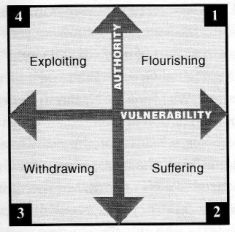
2)  Author and speaker Andy Crouch has taken the two concepts of authority and vulnerability and placed them in a chart to create four quadrants.  Low vulnerability and low authority is labelled as "withdrawing", but it could also be called safety.  An example of this can happen in the type of retirement where a person goes from cruise to excursion but does very little in the way of meaningful action.  Another form of safety comes when a person has a great deal of authority over others and because of wealth experiences very little vulnerability.  This person feels that he or she is invincible, and the result is exploitation towards those lower in status. The ideal place to be, according to Crouch is where both authority (meaningful action) and vulnerability are both high.  To be fully human we need to acknowledge and not fight against the limits placed upon us as human beings.   Something my family did in 2015 would seem risky to many people.  We opened our home to a person we knew almost nothing about: a young woman fleeing a war-torn nation as a refugee.  And yet, from oldest to youngest we all agree that the eight months she lived with us made us individually and as a family more compassionate, flexible and patient, more into the people God wants us to be. This risk led to flourishing for not only ourselves but for the person we embraced, and the ongoing relationship will continue to shape us.

https://paulwilkinson.files.wordpress.com/2016/02/andy-crouch-strong-and-weak.jpg?w=235&h=232


3)  Clay Water Brick by Jessica Jackley, which I just finished reading, also talks about risk.  Jackley was co-founder of the non-profit organization KIVA, which allows everyday people to provide micro-loans to entrepreneurs around the world.  The stories she shares about these resourceful individuals who raise chickens, learned to bake their own bricks and operate market stalls are meant to teach all readers, business-minded or not, that opportunities are meant to be picked up.  Finding the right match between our passions and the needs around us (the definition Fredrick Buechner gives to vocation or "calling") involves becoming vulnerable.  We may not always get it right, but in the process we learn and grow.  Doing what is familiar and conventional has its place, but stepping out into uncharted territory when that is God's clear call on one's life will bring struggle and growth.
   Pursuing further education is another risk at my doorstep, but seeing it as an opportunity for growth changes my perspective and lends me courage.

Wednesday, 9 March 2016

The Golden Rule and Giving

   We generally agree that giving is a good thing.  After all, Jesus is quoted by the Apostle Paul as having said, "It is more blessed to give than to receive."  Still, it is quite easy for giving to go wrong. To avoid each pitfall below, the golden rule of doing to others what we would have them do to us is instructive.

1.  Giving can become a matter of pride
   When one is in the position of being able to give to another, it is possible to look down upon the recipient of that charity as being less valuable.  The "needy" can be made into an object rather than being seen as a human being with feelings and dignity.  The giver should call to mind that everything with which he or she has been blessed ultimately came from God and is not to be a matter of pride. In our lives we will experience times when we need the help of others and times when we can provide help for others.  Seeing everyone, no matter their level of need, as someone created in God's image will help us avoid becoming arrogant.
   An example of a good practice I am aware of is that performed by the development agency World Vision.  Every community where it seeks to work by bringing relief and development, its representatives meet with community leaders to determine what assets the community already has.  It consults them as well as to what their hopes and dreams are for the community so that a true partnership is forged based on humility and mutual respect.

2.  Giving can be thoughtless
   Thinking that people in need should be grateful for any old thing given to them can lead to thoughtless giving.  Such giving is seen during food drives when dented cans and products past the best before date are donated.  Clothing given to the needy is sometimes ripped, soiled or missing buttons. Whatever a person plans to give should be something they themselves would be willing to receive.
   I am reminded of an episode in a radio drama where a young boy wins a new bike.  He knows of another child in need of a bike, so he plans to give him his old bike.  As a surprise, he leaves it at the curb of the needy boy's laneway only to have the garbage truck take it away.  In the end, he is convicted to give his brand new bike to this other boy, and he follows through.  It is a great story because it challenges one's natural inclinations.  It's easy to give away what one doesn't really like or need anymore.  The attitude of "What's mine is mine" can be overcome by living out the golden rule.

3.  Giving can be impersonal
   When we give a monetary donation, it can easily become another financial transaction, not unlike paying the utility bill.  When an amount of money is given through an agency, the personal impact of that gift is often brief and momentary.  A computer generated thank you letter telling how much the gift is appreciated does not genuinely allow the donor to see who benefited or how.
   The fourth grade class at my school recently learned how giving can be personal and more authentic. The framed photos of two Ugandan girls are front and centre in their classroom as a reminder of the reason they raised over $2,500 CAD: to sponsor their life-saving surgeries. Not only was money sent, but notes of encouragement and many prayers for their recovery and well-being continue to be offered.  A long-term personal connection has been made between the donors and the ones they helped.

Having the right posture when giving makes all the difference.  Humility, thoughtfulness and relationship elevates any gift from being a mere transaction.


Saturday, 20 February 2016

When "Cheap" Makes me Cringe

   Most of the time I am able to convince myself that I am not a contributor to the world economy and its materialistic values.  Because I purchase almost all my clothing second-hand, I can say I am one step removed from the fashion industry and the exploitation of textile workers overseas.  Since I do not own a hand-held electronic device that is designed to become obsolete in a short period of time, I can tell myself that the way electronics are made and distributed is not my issue.  Except that in the past 30 days, I realized that I am an unwilling contributor to the world economy that wants everything cheap.
Exhibit A: Computer Modem
   The modem we had been using for our DSL internet connection stopped working last month.  Our internet provider was willing to mail us one for $75 plus $10 shipping, but we thought we would check local stores instead.  My husband found a modem for less than $30 before taxes.  What a great deal, I thought for a moment. But then I began to feel bad.  How could this bundle of electronics cost so little?   The shipping cost, the labour cost for the manufacture, the labour cost for the vendor, the labour cost for the person who unloads the shipping container and the profit margin all add up to $27 and change?  Something is wrong here.
   I thought back to when I first moved to this community and there was so much buzz about the Blackberry Company.  People were eager to work for this technology company, except those on the assembly line working 12 hour shifts actually assembling the phones.  Wherever there is greed, there is also injustice [1].

Exhibit B: Undergarments
   One of the clothing items I do not buy second hand is obvious.  When shopping for more of these last weekend, I found myself questioning their source.  Product of China, Bangladesh, Pakistan, Indonesia, Cambodia.  When I look at the seams, stitches and elastic, I wonder how hard it is to make a pair of underwear.  With the right equipment, workers might be able to finish a pair in a few minutes.  But what kind of conditions do they work in?  Do they get breaks?  Is there a boss who keeps demanding a higher work quota?  I don't know the answers, but I remember when the garment factory in Bangladesh collapsed three years ago.  Some companies may try to distance themselves from unjust labour practices, but I cannot grasp how the price of some types of clothing is less now than it was 30 years ago. 
   If I go to the big name stores, there are no options for buying Canadian or American made undies.  I caved in this time, but next time I will do whatever it takes to buy fair trade underwear, even if they cost $17 a pair.  

I'm just one person.  I can't change the world system, but I can strive to make more ethical purchases. And I can share my angst when I am unsuccessful.

[1] The link between idolatry (greed is just one idol) and injustice is a main theme of Andy Crouch's book Playing God.